Category: Astronomy

  • Astronomy Video of the Day | Clouds and Stars over Cotopaxi Volcano in Ecuador

    [youtube=http://www.youtube.com/watch?v=6B0Kd9vk11Y&hl=en_US&fs=1&color1=0x006699&color2=0x54abd6]

    Clouds and Stars over Cotopaxi Volcano in Ecuador

    Credit & Copyright: Stéphane Guisard (Los Cielos de America), TWAN

    Explanation: What’s happening above the Cotopaxi volcano in Ecuador? Quite a bit, from the looks of the above one-night, time-lapse movie, taken earlier this month. The majestic volcano is first seen through breaks in fast moving clouds as the movie begins. Soon the clouds have dissipated and a sky filled with stars seems to rotate about the snow-peaked volcano’s peak. The band of our Milky Way Galaxy, the dark Coal Sack nebula, and the Southern Cross can all be seen overhead. Satellites streak by from several directions. Soon thin clouds roll by and seem to make the brightest stars sparkle. On the volcano (starting at about 1:13 of the movie), the lights of climbers flash. Near the end of the movie, a bright airplane passes over the peak with a residual trail seen drifting away.

  • Astronomy Picture of the Day – Scattered Light from the Boomerang Nebula

    The Hubble Space Telescope caught the Boomerang Nebula in this image taken with the Advanced Camera for Surveys in early 2005. This reflecting cloud of dust and gas has two nearly symmetric lobes of matter that are being ejected from a central star.

    Hubble Catches Scattered Light from the Boomerang Nebula. Credit: NASA, ESA and The Hubble Heritage Team STScI/AURA)

    Each lobe of the nebula is nearly one light-year in length, making the total length of the nebula half as long as the distance from our Sun to our nearest neighbors – the alpha Centauri stellar system, located roughly 4 light-years away. The Boomerang Nebula resides 5,000 light-years from Earth. Hubble’s sharp view is able to resolve patterns and ripples in the nebula very close to the central star that are not visible from the ground.

  • Astronomy Picture of the Day – Mature Galaxy Masquerading as Toddler

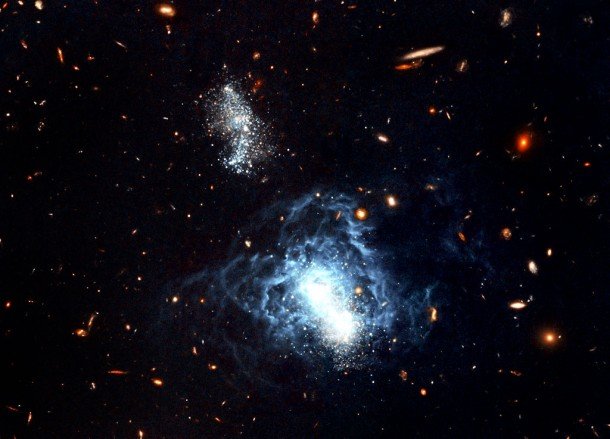
    The Hubble Space Telescope quashed the possibility that what was previously believed to be a toddler galaxy in the nearby universe may actually be considered an adult. Called I Zwicky 18, this galaxy has a youthful appearance that resembles galaxies typically found only in the early universe. Hubble has now found faint, older stars within this galaxy, suggesting that the galaxy may have formed at the same time as most other galaxies.

    Hubble Finds Mature Galaxy Masquerading as Toddler. Credit: NASA, ESA, and A. Aloisi (European Space Agency and Space Telescope Science Institute)

    I Zwicky 18 is classified as a dwarf irregular galaxy and is much smaller than our Milky Way Galaxy. The concentrated bluish-white knots embedded in the heart of the galaxy are two major starburst regions where stars are forming at a furious rate. The wispy blue filaments surrounding the central starburst regions are bubbles of gas that have been blown away by stellar winds and supernovae explosions from a previous generation of hot, young stars. This gas is now heated by intense ultraviolet radiation unleashed by hot, young stars.

    A companion galaxy lies just above and to the left of I Zwicky 18. The companion may be interacting with I Zwicky 18 by gravitationally tugging on the galaxy. The interaction may have triggered the galaxy’s recent star formation that is responsible for the youthful appearance. Besides the bluish-white young stars, white-reddish stars also are visible in both I Zwicky 18 and its companion. These stars may be as old as 10 billion years. The reddish extended objects surrounding I Zwicky 18 and its companion are ancient, fully formed galaxies of different shapes that are much farther away.

    Hubble data also allowed astronomers for the first time to identify Cepheid variable stars in I Zwicky 18. These flashing stellar mile-markers were used to determine that I Zwicky 18 is 59 million light-years from Earth, almost 10 million light-years more distant than previously believed.

    The observations of I Zwicky 18 were taken in 2005 and 2006 with Hubble’s Advanced Camera for Surveys. Astronomers made this image by combining observations taken with blue and red filters.

    The science team consists of Alessandra Aloisi and Marco Sirianni of the European Space Agency and Space Telescope Science Institute; Francesca Annibali,Jennifer Mack, and Roeland van der Marel of the Space Telescope Science Institute; Abhijit Saha of the National Optical Astronomy Observatories; and Gisella Clementini, Rodrigo Contreras, Giuliana Fiorentino, Marcella Marconi, Ilaria Musella, and Monica Tosi of the Italian National Astrophysics Institutes in Bologna and Naples.