Category: Photography

  • Astronomy Picture of the Day | Tapestry of Star Birth in a Neighbouring Galaxy

    The Hubble Space Telescope captures the iridescent tapestry of star birth in a neighbouring galaxy in this panoramic view of glowing gas, dark dust clouds, and young, hot stars. The star-forming region, catalogued as N11B lies in the Large Magellanic Cloud (LMC), located only 160,000 light-years from Earth.

    With its high resolution, the Hubble Space Telescope is able to view details of star formation in the LMC as easily as ground-based telescopes are able to observe stellar formation within our own Milky Way galaxy.

    Our neighbourhood galaxy the Large Magellanic Cloud (LMC) lies in the Constellation of Dorado and is sprinkled with a number of regions harbouring recent and ongoing star formation. One of these star-forming region, N11B, is shown in this Hubble image. It is a subregion within a larger area of star formation called N11. N11 is the second largest star-forming region in LMC. It is only surpassed in the size and activity by “the king of stellar nurseries”, 30 Doradus, located at the opposite side of LMC.

    Posted via web from Monicks: Unleashed

  • Astronomy Picture of the Day – Ghostly Reflections in the Pleiades

    This image shows a dark interstellar cloud ravaged by the passage of Merope, one of the brightest stars in the Pleiades star cluster. Just as a torch beam bounces off the wall of a cave, the star is reflecting light from the surface of pitch-black clouds of cold gas laced with dust.

    As the nebula approaches Merope, the strong starlight shining on the dust decelerates the dust particles. The nebula is drifting through the cluster at a relative speed of roughly 11 kilometres per second.

    The Hubble Space Telescope has caught the eerie, wispy tendrils of a dark interstellar cloud being destroyed by the passage of one of the brightest stars in the Pleiades star cluster. Like a flashlight beam shining off the wall of a cave, the star is reflecting light off the surface of pitch black clouds of cold gas laced with dust. These are called reflection nebulae.

    Posted via web from Monicks: Unleashed

  • Astronomy Picture of the Day – A Runaway Galaxy | International Space Fellowship

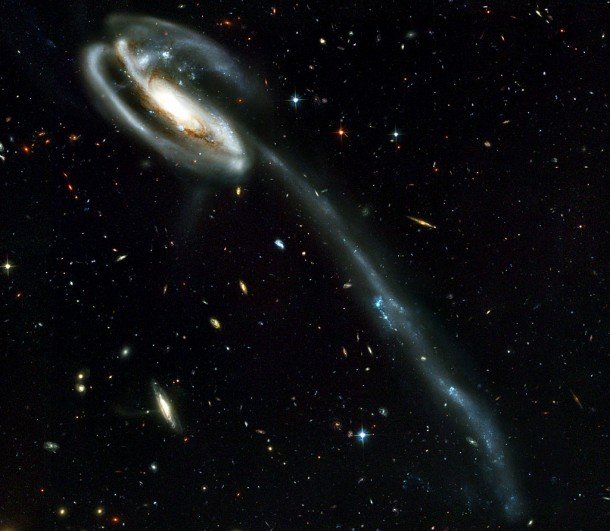
    This picture of the galaxy UGC 10214 was taken by the Advanced Camera for Surveys (ACS), which was installed aboard the NASA/ESA  Hubble Space Telescope in March during Servicing Mission 3B. Dubbed the ‘Tadpole’, this spiral galaxy is unlike the textbook images of stately galaxies. Its distorted shape was caused by a small interloper, a very blue, compact, galaxy visible in the upper left corner of the more massive Tadpole. The Tadpole resides about 420 million light-years away in the constellation Draco.


    Against a stunning backdrop of thousands of galaxies, this odd-looking galaxy with the long streamer of stars appears to be racing through space, like a runaway pinwheel firework. Credit: NASA, the ACS Science Team

    Seen shining through the Tadpole’s disc, the tiny intruder is likely a hit and run galaxy that is now leaving the scene of the accident. Strong gravitational forces from the interaction created the long tail of stars and gas stretching out more than 280 000 light-years.

    Numerous young blue stars and star clusters, spawned by the galaxy collision, are seen in the spiral arms, as well as in the long ‘tidal’ tail of stars. Each of these clusters represents the formation of up to about a million stars. Their colour is blue because they contain very massive stars, which are 10 times hotter and 1 million times brighter than our Sun. Once formed, the star clusters become redder with age as the most massive and bluest stars exhaust their fuel and burn out. These clusters will eventually become old globular clusters similar to those found in essentially all halos of galaxies, including our own Milky Way.

    Two prominent clumps of young bright blue stars are visible in the tidal tale and separated by a gap. These clumps of stars will likely become dwarf galaxies that orbit in the Tadpole’s halo.

    Behind the galactic carnage and torrent of star birth is another compelling picture: a ‘wallpaper pattern’ of about 3000 faint galaxies. These galaxies represent twice the number of those found in the legendary Hubble Deep Field, the orbiting observatory’s ‘deepest’ view of the heavens, taken in 1995 by the Wide Field and Planetary Camera 2.

    The galaxies in the ACS picture, like those in the Hubble Deep Field, stretch back to nearly the beginning of time. They are a myriad of shapes and represent fossil samples of the Universe’s 13-billion-year evolution.

    The ACS picture was taken in one-twelfth the time it took to observe the Hubble Deep Field. In blue light, ACS discovered even fainter objects than those in the ‘deep field’.

    The camera’s vision is so sharp that astronomers can identify distant colliding galaxies, the ‘building blocks’ of galaxies, an exquisite ‘Whitman’s Sampler’ of normal galaxies, and presumably extremely faraway galaxies.

    ACS made this observation on 1 and 9 April 2002. The colour image is constructed from three separate images taken in near-infrared, orange, and blue filters.