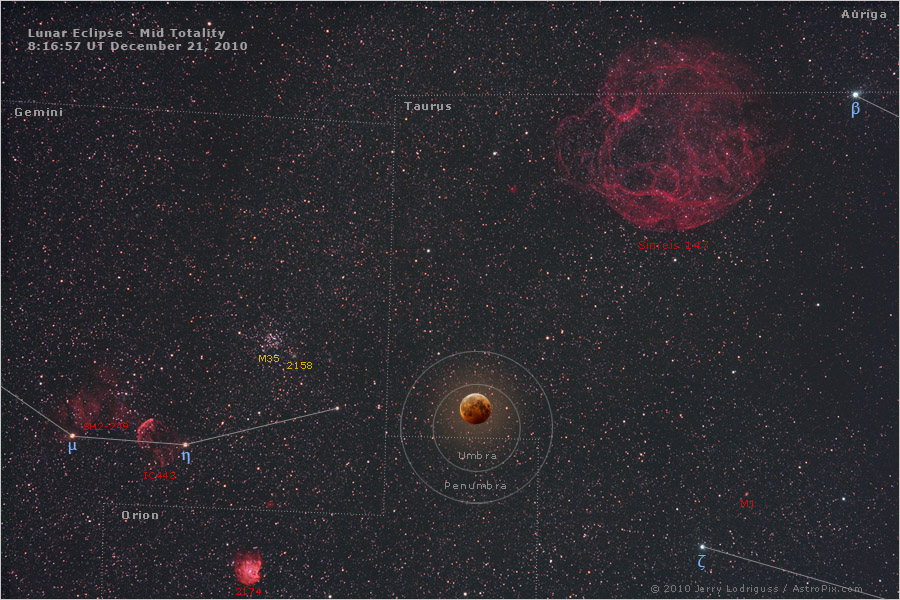
A Lunar Eclipse on Solstice Day
Credit & Copyright: Jerry Lodriguss
(Catching the Light)

A Lunar Eclipse on Solstice Day
Credit & Copyright: Jerry Lodriguss
(Catching the Light)

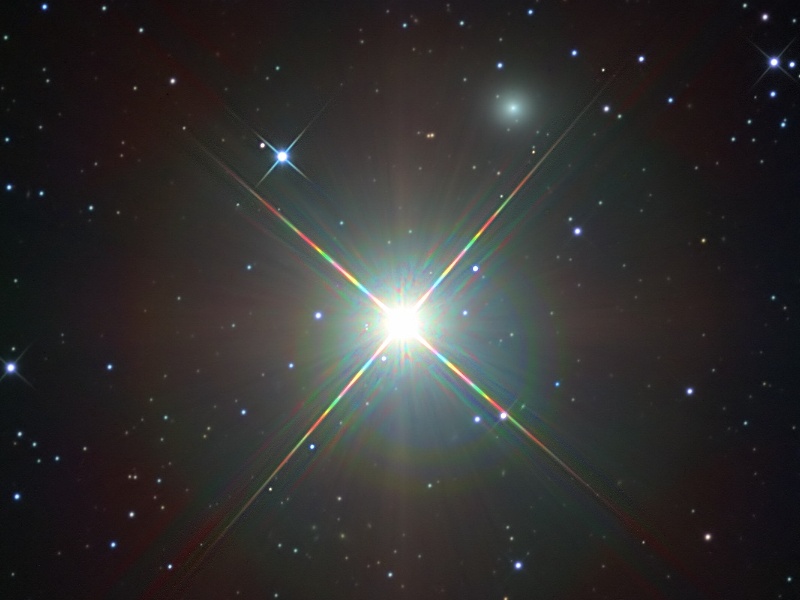
Mirach’s Ghost
Credit & Copyright: Anthony Ayiomamitis (TWAN)
Explanation: As far as ghosts go, Mirach’s Ghost isn’t really that scary. In fact, Mirach’s Ghost is just a faint, fuzzy galaxy, well known to astronomers, that happens to be seen nearly along the line-of-sight to Mirach, a bright star. Centered in this star field, Mirach is also called Beta Andromedae. About 200 light-years distant, Mirach is a red giant star, cooler than the Sun but much larger and so intrinsically much brighter than our parent star. In most telescopic views, glare and diffraction spikes tend to hide things that lie near Mirach and make the faint, fuzzy galaxy look like a ghostly internal reflection of the almost overwhelming starlight. Still, appearing in this sharp image just above and to the right of Mirach, Mirach’s Ghost is cataloged as galaxy NGC 404 and is estimated to be some 10 million light-years away.

Credit: Mac Hunter
Mirach’s ghost is, in itself, not a very interesting galaxy. A small plain looking E-S0 type galaxy. However, its postion about 7 arc minutes from the 2nd magnitude M0 star beta And – known as Mirach – makes it into an interesting photographic target.
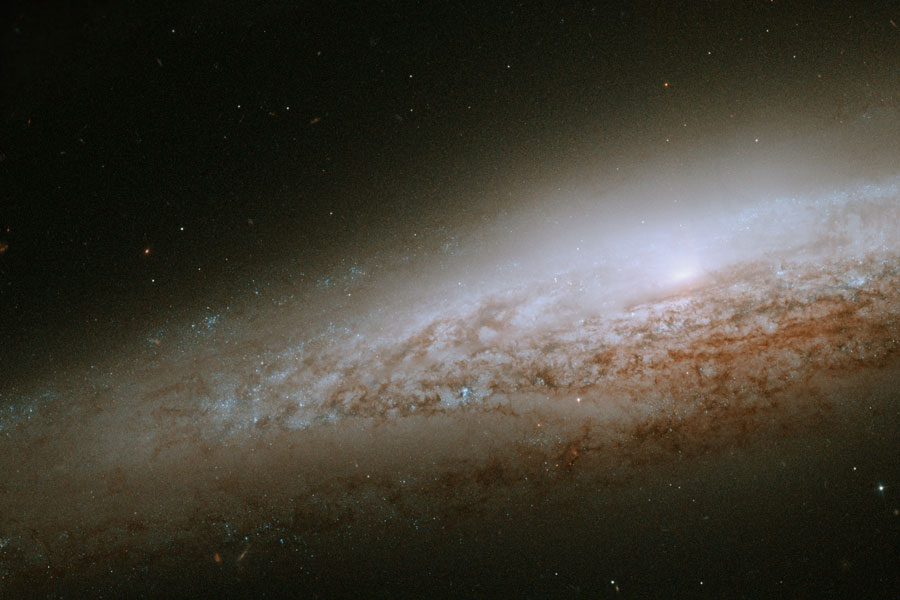
Credit: Data: Hubble Legacy Archive, ESA, NASA; Processing: Nikolaus Sulzenauer
Explanation: Does spiral galaxy NGC 2683 have a bar across its center? Being so nearly like our own barred Milky Way Galaxy, one might guess it has. Being so nearly edge-on, however, it is hard to tell. Either way, this gorgeous island universe, cataloged as NGC 2683, lies a mere 20 million light-years distant in the northern constellation of the Cat (Lynx). NGC 2683 is seen nearly edge-on in this cosmic vista, with more distant galaxies scattered in the background. Blended light from a large population of old yellowish stars forms the remarkably bright galactic core. Starlight silhouettes the dust lanes along winding spiral arms, dotted with the telltale blue glow of young star clusters in this galaxy‘s star forming regions.
NGC 2683 was discovered by William Herschel on February 5, 1788.
This spiral galaxy is viewed nearly edge-on from our perspective. Because of its appearance, it was nicknamed the “UFO Galaxy” by the Astronaut Memorial Planetarium and Observatory site. Note the small yellowish core in the center of the galaxy, consisting of older stars. Also note the fine details of the spiral structure, traced by dark dust in the brighter part of the disk (particularly well visible in the larger image.
The UFO is receding from us at 410 km/s, and from the Galactic Center at 375 km/s. This indicates that it is probably one of the nearby galaxies, perhaps at about 16 million light years.
The image in this page was obtained by Dick Stone when participating in the Kitt Peak Visitor Center’s Advanced Observing Program. It is a composite of 4 CCD images: Luminance = 42 min, Red = 20 min, Green = 20 min, Blue = 40 min.
via apod.nasa.gov