Category: Science

  • Stephen Hawking: Physics Leaves No Room For God

    [youtube=http://www.youtube.com/watch?v=JQvnQD9_l1c]
    Channel 4 News 02 September 2010
    From The Times:
    Modern physics leaves no place for God in the creation of the Universe, Stephen Hawking has concluded.
    Just as Darwinism removed the need for a creator in the sphere of biology, Britain’s most eminent scientist argues that a new series of theories have rendered redundant the role of a creator for the Universe.
    In his forthcoming book, an extract from which is published exclusively in Eureka, published today with The Times, Professor Hawking sets out to answer the question: “Did the Universe need a creator?” The answer he gives is a resounding “no”.
    Far from being a once-in-a-million event that could only be accounted for by extraordinary serendipity or a divine hand, the Big Bang was an inevitable consequence of the laws of physics, Hawking says.
    “Because there is a law such as gravity, the Universe can and will create itself from nothing. Spontaneous creation is the reason there is something rather than nothing, why the Universe exists, why we exist,” he writes.
    “It is not necessary to invoke God to light the blue touch paper and set the Universe going,” he finds.
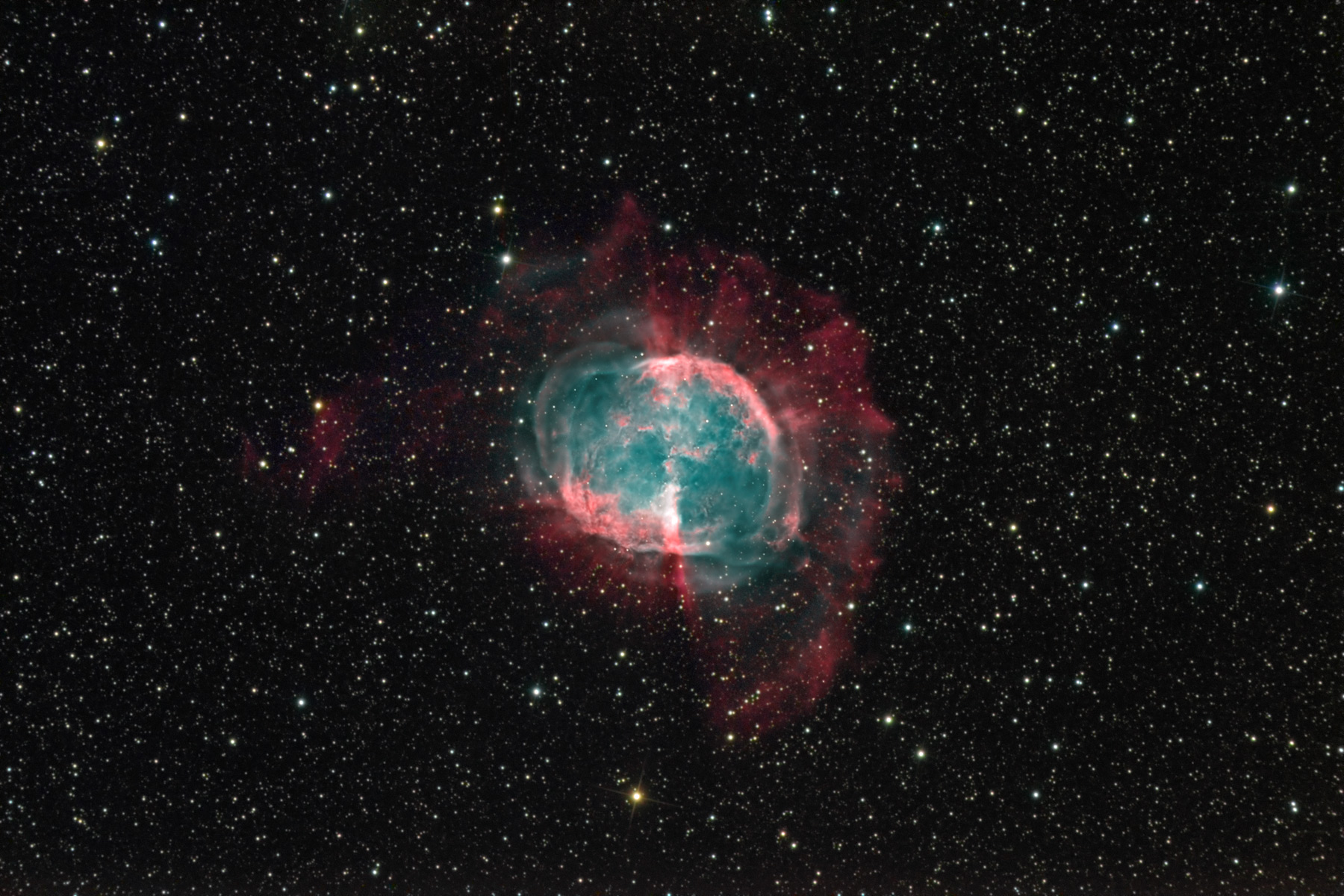
  • Astronomy Picture of the Day | M27: Not a Comet

    M27: Not a Comet
    Credit & Copyright: Matthew T. Russell

    Explanation: While hunting for comets in the skies above 18th century France, astronomer Charles Messier diligently kept a list of the things he encountered that were definitely not comets. This is number 27 on his now famous not-a-comet list. In fact, 21st century astronomers would identify it as a planetary nebula, but it’s not a planet either, even though it may appear round and planet-like in a small telescope. Messier 27 (M27) is an excellent example of a gaseous emission nebula created as a sun-like star runs out of nuclear fuel in its core. The nebula forms as the star’s outer layers are expelled into space, with a visible glow generated by atoms excited by the dying star’s intense but invisible ultraviolet light. Known by the popular name of the Dumbbell Nebula, the beautifully symmetric interstellar gas cloud is over 2.5 light-years across and about 1,200 light-years away in the constellation Vulpecula. This impressive color composite highlights details within the well-studied central region and fainter, seldom imaged features in the nebula’s outer halo. It includes narrowband images recorded using filters sensitive to emission from oxygen atoms, shown in blue-green hues, and hydrogen atoms in red.