
Tag: Astronomy Picture of the Day

  • Astronomy Picture of the Day – Mature Galaxy Masquerading as Toddler

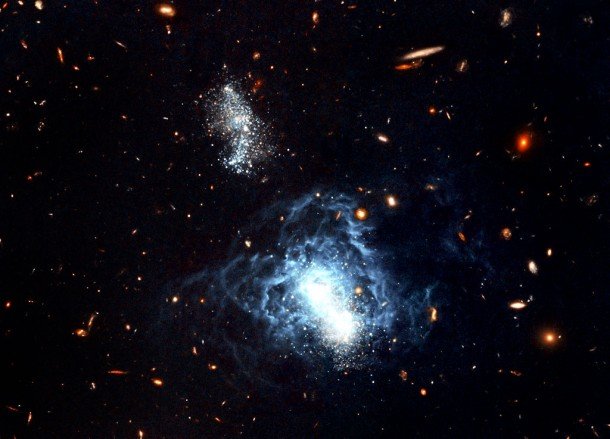
    The Hubble Space Telescope quashed the possibility that what was previously believed to be a toddler galaxy in the nearby universe may actually be considered an adult. Called I Zwicky 18, this galaxy has a youthful appearance that resembles galaxies typically found only in the early universe. Hubble has now found faint, older stars within this galaxy, suggesting that the galaxy may have formed at the same time as most other galaxies.

    Hubble Finds Mature Galaxy Masquerading as Toddler. Credit: NASA, ESA, and A. Aloisi (European Space Agency and Space Telescope Science Institute)

    I Zwicky 18 is classified as a dwarf irregular galaxy and is much smaller than our Milky Way Galaxy. The concentrated bluish-white knots embedded in the heart of the galaxy are two major starburst regions where stars are forming at a furious rate. The wispy blue filaments surrounding the central starburst regions are bubbles of gas that have been blown away by stellar winds and supernovae explosions from a previous generation of hot, young stars. This gas is now heated by intense ultraviolet radiation unleashed by hot, young stars.

    A companion galaxy lies just above and to the left of I Zwicky 18. The companion may be interacting with I Zwicky 18 by gravitationally tugging on the galaxy. The interaction may have triggered the galaxy’s recent star formation that is responsible for the youthful appearance. Besides the bluish-white young stars, white-reddish stars also are visible in both I Zwicky 18 and its companion. These stars may be as old as 10 billion years. The reddish extended objects surrounding I Zwicky 18 and its companion are ancient, fully formed galaxies of different shapes that are much farther away.

    Hubble data also allowed astronomers for the first time to identify Cepheid variable stars in I Zwicky 18. These flashing stellar mile-markers were used to determine that I Zwicky 18 is 59 million light-years from Earth, almost 10 million light-years more distant than previously believed.

    The observations of I Zwicky 18 were taken in 2005 and 2006 with Hubble’s Advanced Camera for Surveys. Astronomers made this image by combining observations taken with blue and red filters.

    The science team consists of Alessandra Aloisi and Marco Sirianni of the European Space Agency and Space Telescope Science Institute; Francesca Annibali,Jennifer Mack, and Roeland van der Marel of the Space Telescope Science Institute; Abhijit Saha of the National Optical Astronomy Observatories; and Gisella Clementini, Rodrigo Contreras, Giuliana Fiorentino, Marcella Marconi, Ilaria Musella, and Monica Tosi of the Italian National Astrophysics Institutes in Bologna and Naples.

  • Astronomy Picture of the Day | Rho Ophiuchi Wide Field

    Rho Ophiuchi Wide Field 
    Credit & Copyright: Rogelio Bernal Andreo

    Explanation: The clouds surrounding the star system Rho Ophiuchi compose one of the closest star forming regions. Rho Ophiuchi itself is a binary star system visible in the light-colored region on the image right. The star system, located only 400 light years away, is distinguished by its colorful surroundings, which include a red emission nebula and numerous light and dark brown dust lanes. Near the upper right of the Rho Ophiuchi molecular cloud system is the yellow star Antares, while a distant but coincidently-superposed globular cluster of stars, M4, is visible between Antares and the red emission nebula. Near the image bottom lies IC 4592, the Blue Horsehead nebula. The blue glow that surrounds the Blue Horsehead’s eye — and other stars around the image — is a reflection nebula composed of fine dust. On theabove image left is a geometrically angled reflection nebula cataloged as Sharpless 1. Here, the bright star near the dust vortex creates the light of surrounding reflection nebula. Although most of these featuresare visible through a small telescope pointed toward the constellations of Ophiuchus, Scorpius, and Sagittarius, the only way to see the intricate details of the dust swirls, as featured above, is to use a long exposure camera.

    Source apod.nasa.gov

  • Astronomy Picture of the Day | Dark Filament of the Sun

    Dark Filament of the Sun 
    Credit: NASA / Goddard / SDO AIA Team

    Explanation: Suspended by magnetic fields above a solar active region this dark filament stretches over 40 earth-diameters. The ominous structure appears to be frozen in time near the Sun’s edge, but solar filaments are unstable and often erupt. The detailed scene was captured on May 18 in extreme ultraviolet light by cameras on board the Solar Dynamics Observatory. While the cooler plasma of the filament looks dark, hotter, brighter plasma below traces magnetic field lines emerging from the active region. When seen arcing above the edge of the Sun, filaments actually look bright against the dark background of space and are called prominences.

    Source