Tag: astronomy

  • Astronomy Picture of the Day – A Lunar Eclipse on Solstice Day

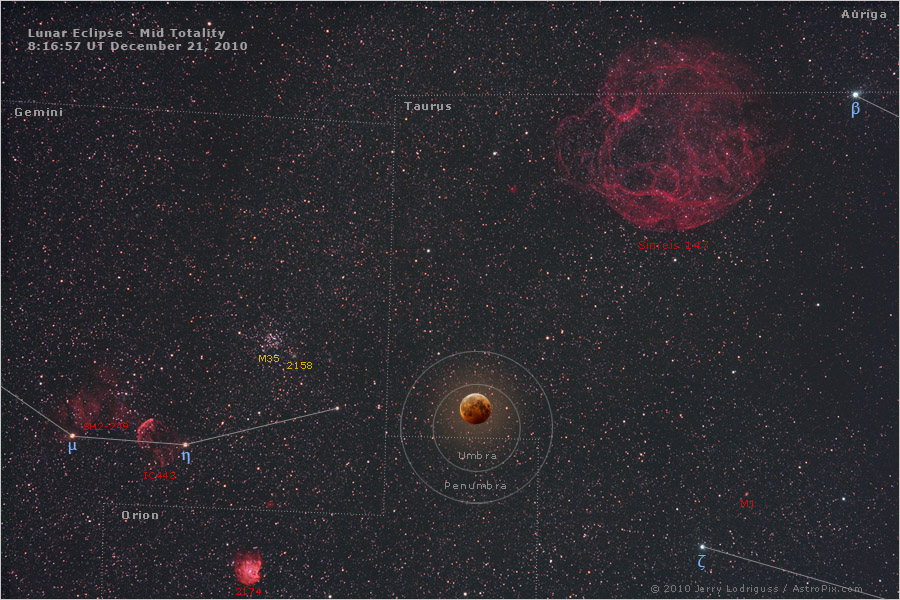
    A Lunar Eclipse on Solstice Day
    Credit & Copyright: Jerry Lodriguss
    (Catching the Light)

  • Astronomy Picture of the Day | Mirach’s Ghost


    Mirach’s Ghost

    Credit & Copyright: Anthony Ayiomamitis (TWAN)

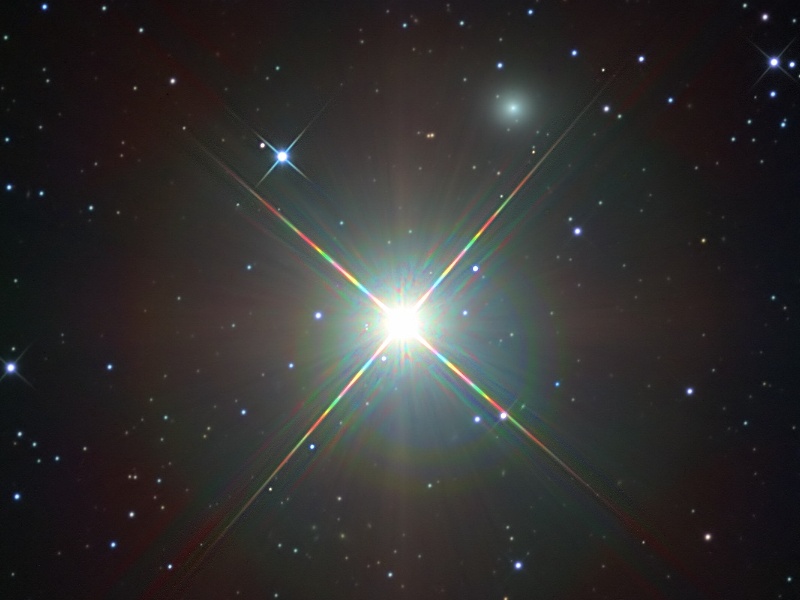
    Explanation: As far as ghosts go, Mirach’s Ghost isn’t really that scary. In fact, Mirach’s Ghost is just a faint, fuzzy galaxy, well known to astronomers, that happens to be seen nearly along the line-of-sight to Mirach, a bright star. Centered in this star field, Mirach is also called Beta Andromedae. About 200 light-years distant, Mirach is a red giant star, cooler than the Sun but much larger and so intrinsically much brighter than our parent star. In most telescopic views, glare and diffraction spikes tend to hide things that lie near Mirach and make the faint, fuzzy galaxy look like a ghostly internal reflection of the almost overwhelming starlight. Still, appearing in this sharp image just above and to the right of Mirach, Mirach’s Ghost is cataloged as galaxy NGC 404 and is estimated to be some 10 million light-years away.

    Credit: Mac Hunter

    Mirach’s ghost is, in itself, not a very interesting galaxy. A small plain looking E-S0 type galaxy. However, its postion about 7 arc minutes from the 2nd magnitude M0 star beta And – known as Mirach – makes it into an interesting photographic target.

  • Gliese 581g – The next “Earth”?

    [youtube=http://www.youtube.com/watch?v=M6_HooIJLNc]
    The fact that we’ve found a habitable planet candidate so soon after starting our search has important implications for the number of habitable planets that may exist in our galaxy – which was estimated to be around 10 billion. 

    Having found Gliese 581g so soon though, may mean one of two things. Either we were very lucky, or there are more planets out there than we thought. Based on this discovery, it’s possible that we may have many more habitable planets than originally thought.

    Perhaps 20 to 30 billion stars in our galaxy may have conditions suitable for life.