
Tag: astrophysics

  • Astronomy Picture of the Day | Companion of a Young, Sun-like Star Confirmed

    Companion of a Young, Sun-like Star Confirmed
    Credit: Gemini Observatory, D. Lafreniere, R. Jayawardhana, M. van Kerkwijk (Univ. Toronto)

    Explanation: The first direct image of an extrasolar planet orbiting a star similar to our Sun has been confirmed. Located just 500 light-years away toward the constellation Scorpius, the parent star, cataloged as 1RXS J160929.1-210524, is only slightly less massive and a little cooler than the Sun. The star is, however, much younger, a few million years old compared to the middle-aged Sun’s 5 billion years. This sharp infrared image shows the young star’s planetary companion positioned above and left of center. The planet is estimated to have a mass about 8 times the mass of Jupiter, and orbit a whopping 330 times the Earth-Sun distance from its parent star. The young planetary companion is still hot and relatively bright in infrared light, likely due to the heat generated during its formation by gravitational contraction. In fact, such newborn planets are easier to detect before they age and cool and become much more faint. The discovery image, shown above, was taken in 2008 but confirmed only recently by noting that the planet stayed with its parent star as background stars slightly shifted over time.

  • Astronomy Picture of the Day | Hubble Remix: Active Galaxy NGC 1275

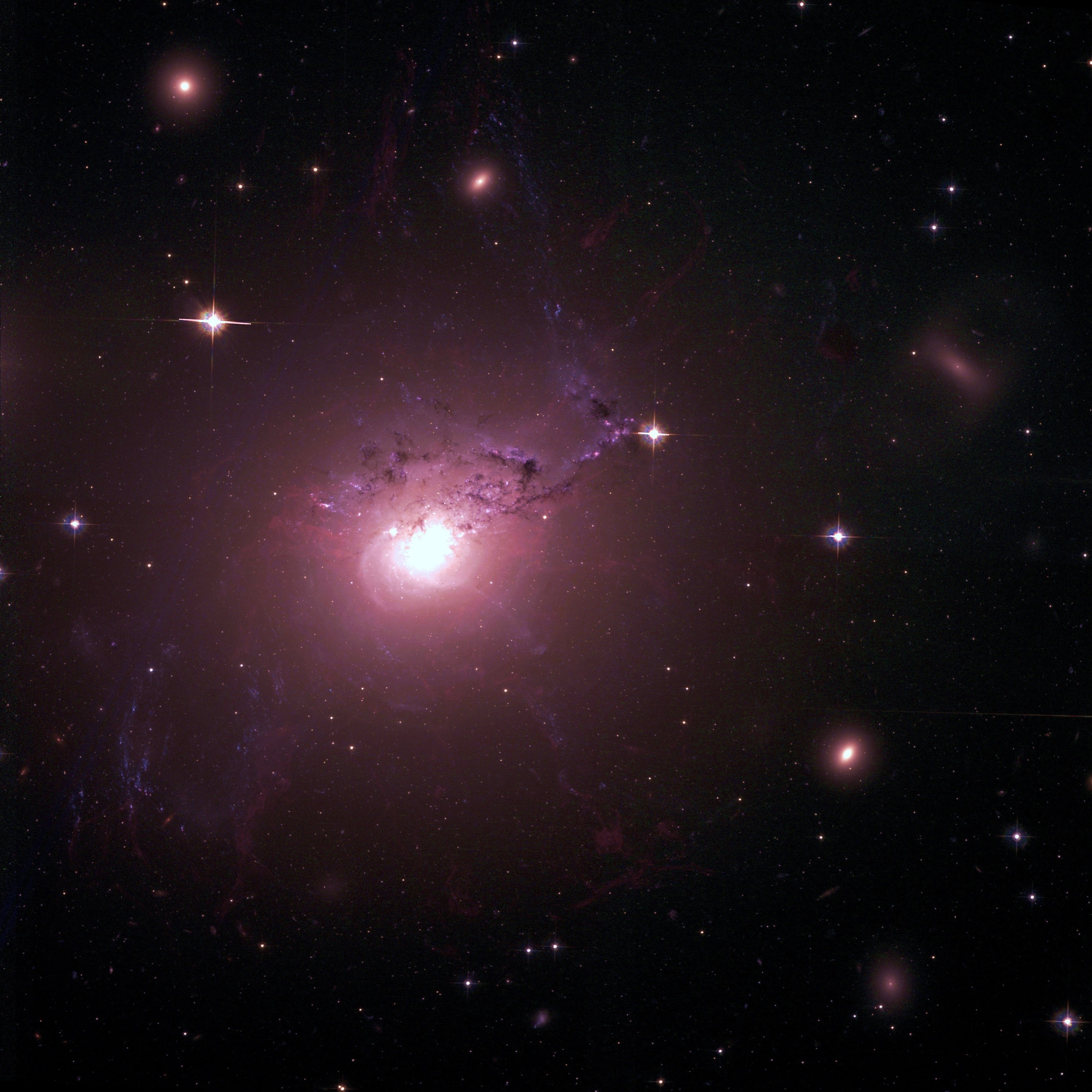
    Hubble Remix: Active Galaxy NGC 1275
    Credit: DataHubble Legacy Archive, ESA, NASA

    Explanation: Active galaxy NGC 1275 is the central, dominant member of the large and relatively nearby Perseus Cluster of Galaxies. Wild-looking at visible wavelengths, the active galaxy is also a prodigious source of x-rays and radio emission. NGC 1275 accretes matter as entire galaxies fall into it, ultimately feeding a supermassive black hole at the galaxy’s core. This color composite image, recreated from archival Hubble Space Telescope data, highlights the resulting galactic debris and filaments of glowing gas, some up to 20,000 light-years long. The filaments persist in NGC 1275, even though the turmoil of galactic collisions should destroy them. What keeps the filaments together? Observations indicate that the structures, pushed out from the galaxy’s center by the black hole’s activity, are held together by magnetic fields. Also known as Perseus A, NGC 1275 spans over 100,000 light years and lies about 230 million light years away.

  • Astronomy Picture of the Day | The Dark Tower in Scorpius

    Image Credit & Copyright: Thomas V. Davis

    This object is an obscure cometary globule in Scorpius. I think the name came from John Gleason who imaged it in h-alpha. Actually only a few images of it exist, all I believe taken in h-alpha except for David Malin’s color film version. Its a cool target and seems to be the southern hemisphere’s equivalent to Vdb 142 (IC1396A). I hope you enjoy it.

    Bright rimmed globules and their more evolved cousin the cometary globule represent fascinating dynamic structures formed by the interplay of cold molecular clouds and hot ionizing stars. Typically the head of the globule faces a hot O-type star. Intense radiation from the star boils away lower density gas from the head. The evaporated rim of gas becomes ionized by the stars ultraviolet flux forming a bright glowing rim we associate with many of these globules including CG4. Intense stellar winds from the ionizing star evaporate gas and dust away from the head forming the “tail” and completing the cometary shape. The globules are known to be the birthplace of low mass stars. Stars form within the globules by the mechanism known as “radiation driven implosion”. This process occurs when ultraviolet flux from a hot star compresses surviving clumps of cold molecular gas eventually causing collapse and core formation within the dense compact clouds. Lower and intermediate mass stars ultimately form from the compact gas and dust within the globules.

    In silhouette against a crowded star field toward the constellation Scorpius, this dusty cosmic cloud evokes for some the image of an ominous dark tower. In fact, clumps of dust and molecular gas collapsing to form stars may well lurk within the dark nebula, a structure that spans almost 40 light-years across the gorgeous telescopic view. Known as a cometary globule, the swept-back cloud, extending from the lower left to the head (top of the tower) right and above center, is shaped by intense ultraviolet radiation from the OB association of very hot stars in NGC 6231, off the right edge of the scene. That energetic ultraviolet light also powers the globule’s bordering reddish glow of hydrogen gas. Hot stars embedded in the dust can be seen as bluish reflection nebulae. This dark tower, NGC 6231, and associated nebulae are about 5,000 light-years away.