Tag: Atheism

  • We are insignificant…and that is awesome!

    We are insignificant…and that is awesome!

    The picture that science presents to us is, in some sense, uncomfortable because what we’ve learned is that we are more insignificant than we ever could have imagined. You could get rid of us and all the galaxies and everything we see in the universe and it will be largely the same. So we’re insignificant on a scale that Copernicus never would have imagined. And in addition, it turns out the future is miserable. So the two main lessons that I like to say I like to give is first we’re insignificant and second the future is miserable. Now that – you might think that should depress you, but I would argue that, in fact, it should embolden you and provide you a different kind of consolation.

    Because if the universe doesn’t care about us and if we’re an accident in a remote corner of the universe, in some sense it makes us more precious. The meaning in our lives is provided by us; we provide our meaning. And we are here by accidents of evolution and the formation of planets and we should enjoy our brief moment in the sun. We should make the most of our brief moment in the sun because this is all we have.

    And even if we’re so rare that we’re the only life forms in the universe, which I doubt, that makes us, in some sense, while we’re more insignificant, we’re more special. We are endowed with a consciousness that can ask questions about the beginning of the universe and learn about the universe on its largest scales and experience everything that it means to be human. Music, art, literature, and science. So for me it should be spiritually uplifting that we’re not created with a purpose by someone who takes care of us, like a mannequin or with strings determining everything. We determine our future. And that makes our future more precious.

  • Atheists have no moral compass

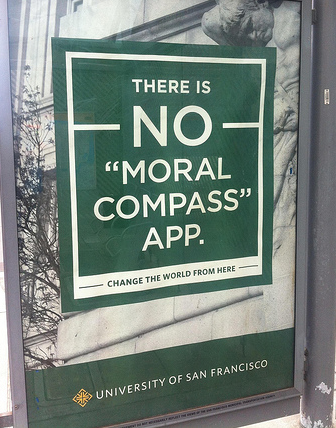
    Atheists have no moral compass

    One of the most perplexing, and recurring misconceptions about nonbelievers is that we have no moral compass. It has happened to me countless times, and if you’re like me, I’m sure it has happened to you, too. This inane idea that presupposes that atheists are unethical, horrible people, for morals can only come from god, and that ultimately atheists have no reason to be good, for they have no one to whom they must answer for their evil deeds…

    **facepalm**

    What is actually ironic is that atheists prove this assertion wrong every step of the way.

    OK, before you people get all literal on me, let’s define moral behavior, shall we? In my opinion it boils down to two basic considerations: Always minimize actual and potential suffering; always maximize actual and potential happiness.

    Please, don’t get me wrong. I am not saying that this is a characteristic exclusive to atheists — Nor am I saying that religious people are immoral. In fact, this is a feature common to all human beings, there are plenty of reasons for my assertion. Let’s explore a few of them:

    Neuro-chemistry — Oxytocin: It’s been scientifically studied that it affects our moral behavior. Paul Zak explains it on his TED Talk Trust, morality — and oxytocin.

    Empathy: You have most likely heard about empathy, haven’t you? It is what allows us to infer how other people feel in a particular situation. Unless you are a troubled individual with a history of abuse, or some specific psychological disorder, it is not in you to see anyone suffer, let alone would you want to ever be the cause of his or her affliction.

    Self-esteem: Let’s face it, nobody wants to feel like a pariah. It makes us feel good when we do good things for other people.

    Morality is a function of society, it comes from reason which precedes religions and best-selling-book author/gods, or supernatural constructs. They may have worshiped the moon and the sun, but they didn’t have the set of rules that religionists claim to be the absolute moral guide. Think about it — hadn’t it been for evolution and reason, humankind wouldn’t have been so successful. The first humans in Africa didn’t have anyone to teach them about gods and morality, it was how these early communities thrived — helping one another.

    We have no need for an external moral compass. We are moral because it is truly in us to be so. We are ethical because it is an inherent part of our character.

    This is precisely why atheists are bewildered by the recurring question believers pose to us on how will we know not to murder and rape without religion telling us not to do it. When you use this argument, to me it is terrifying. Basically what you are saying is that what stands between you and a serial killer is a fragile belief in a supernatural deity made up by illiterate people trying to figure out why the sun hid at night. The irony here is that believers use this argument supposedly from a position of moral superiority. No, this doesn’t go over well, theists.

    Finally, I would like to leave you with this thought: If you think an ancient book is the ultimate guide of morality, think again. This is a book where slavery is condoned, where rape is a matter of property, and where the main character demands of us that we murder people for imaginary crimes, like witchcraft.

    Related articles

    Bible verses on family values (monicks.net)
    Atheism and Spirituality – Ricky Gervais Explains How Atheists Have a Moral Compass Too (TrendHunter.com) (trendhunter.com)

  • One of the greatest gifts…

    One of the greatest gifts…


    ❝One of the greatest gifts science has brought to the world is continuing elimination of the supernatural, and it was a lesson that my father passed on to me, that knowledge liberates mankind from superstition. We can live our lives without the constant fear that we have offended this or that deity who must be placated by incantation or sacrifice, or that we are at the mercy of devils or the Fates. With increasing knowledge, the intellectual darkness that surrounds us is illuminated and we learn more of the beauty and wonder of the natural world.❞

    Molecular Biologist James D. Watson, Darwin: The Indelible Stamp: The Evolution of an Idea