
Tag: black hole
-
Hubble Catches Stars on the Move
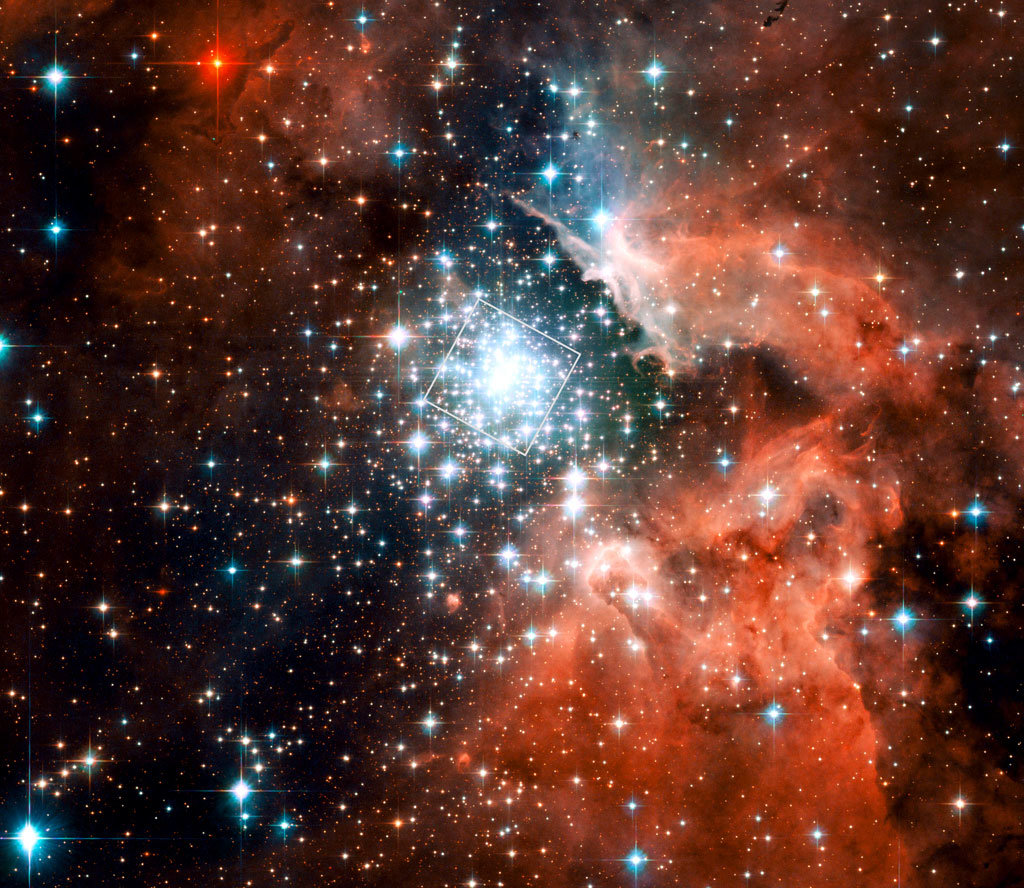
There are surprising signs of unrest in a massive cluster of stars. By comparing observations made ten years apart of the nebula NGC 3603, astronomers have for the first time measured the tiny motions of several hundred young stars.
This view of the rich star formation region NGC 3603 and its massive compact central star cluster was taken with the Advanced Camera for Surveys on the NASA/ESA Hubble Space Telescope. The region that was studied in detail to detect the motion of stars within the cluster is shown as a box. Credits: NASA/ESA/Hubble Heritage (STScI/AURA)Enlarge spacefellowship.com
The stars are moving in ways that are at odds with our understanding of how such clusters evolve, showing that the stars in the cluster have not ‘settled down’ as expected.
With a mass of more than 10 000 Suns packed into a volume a mere three light-years across, the dense young cluster is one of the most compact in the Milky Way and an ideal place to test theories of their formation.
The cluster, formally known as the NGC 3603 Young Cluster, is some 20 000 light-years from the Sun, which makes these measurements extraordinarily difficult. It is necessary to compare images taken years apart. The telescope and camera must give very sharp images and be extremely stable over long periods.
A team of astronomers from the Max-Planck Institute for Astronomy in Heidelberg and the University of Cologne, led by Wolfgang Brandner (MPIA), realised that the exquisite image quality of the NASA/ESA Hubble Space Telescope made it perfect for the job.
-
Astronomy Picture of the Day | The Blinking Galaxy

NGC 6118, a grand-design spiral galaxy, shines bright in this image, displaying its central bar and tight spiral arms from its home in the constellation of Serpens (The Snake). The galaxy is sometimes known to amateur astronomers as the “Blinking Galaxy” because this relatively faint, fuzzy object would appear to flick into existence when viewed through their telescopes in a certain orientation, and then suddenly disappear again as the eye position shifted. The brilliant blue star-forming regions of the galaxy, where hot young stars are born, are beautifully illuminated, even from over 80 million light-years away. In 2004, regular observers of this galaxy saw a “new star” appear near the edge of the galaxy (above the centre of the image). Far from being a new star, this object, supernova 2004dk, is in fact the final, powerful burst of light emitted by the explosion of a star.
Though shy to lesser telescopes, the galaxy cannot hide from ESO’s Very Large Telescope (VLT) at Cerro Paranal, Chile. The image was obtained using the VIsible MultiObject Spectrograph (VIMOS) at the VLT.
Credit: ESO

