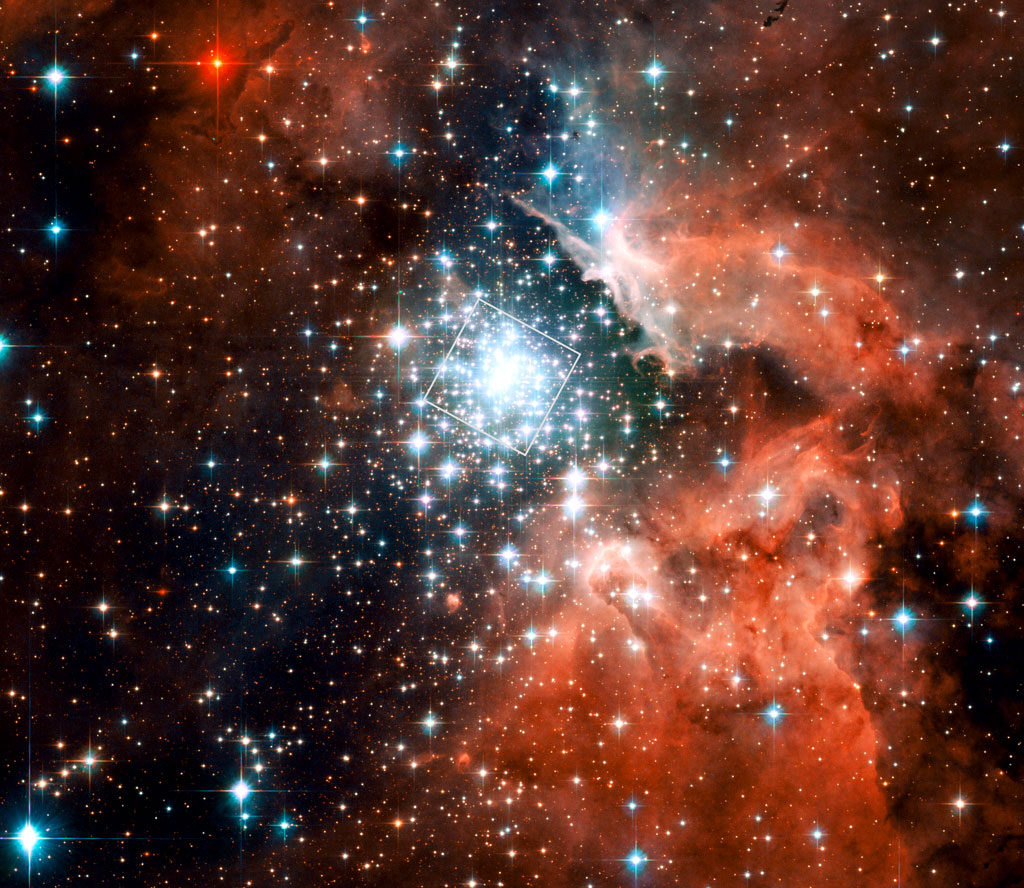
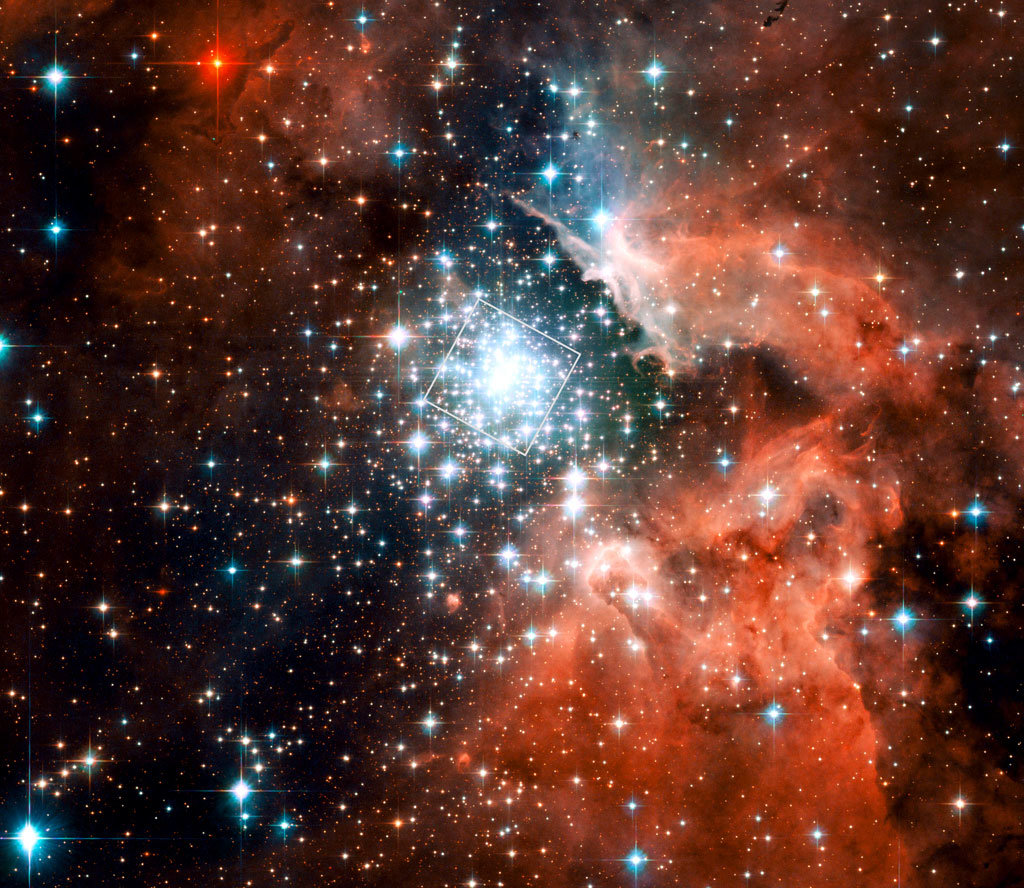
There are surprising signs of unrest in a massive cluster of stars. By comparing observations made ten years apart of the nebula NGC 3603, astronomers have for the first time measured the tiny motions of several hundred young stars.
Enlarge spacefellowship.com
The stars are moving in ways that are at odds with our understanding of how such clusters evolve, showing that the stars in the cluster have not ‘settled down’ as expected.
With a mass of more than 10 000 Suns packed into a volume a mere three light-years across, the dense young cluster is one of the most compact in the Milky Way and an ideal place to test theories of their formation.
The cluster, formally known as the NGC 3603 Young Cluster, is some 20 000 light-years from the Sun, which makes these measurements extraordinarily difficult. It is necessary to compare images taken years apart. The telescope and camera must give very sharp images and be extremely stable over long periods.
A team of astronomers from the Max-Planck Institute for Astronomy in Heidelberg and the University of Cologne, led by Wolfgang Brandner (MPIA), realised that the exquisite image quality of the NASA/ESA Hubble Space Telescope made it perfect for the job.