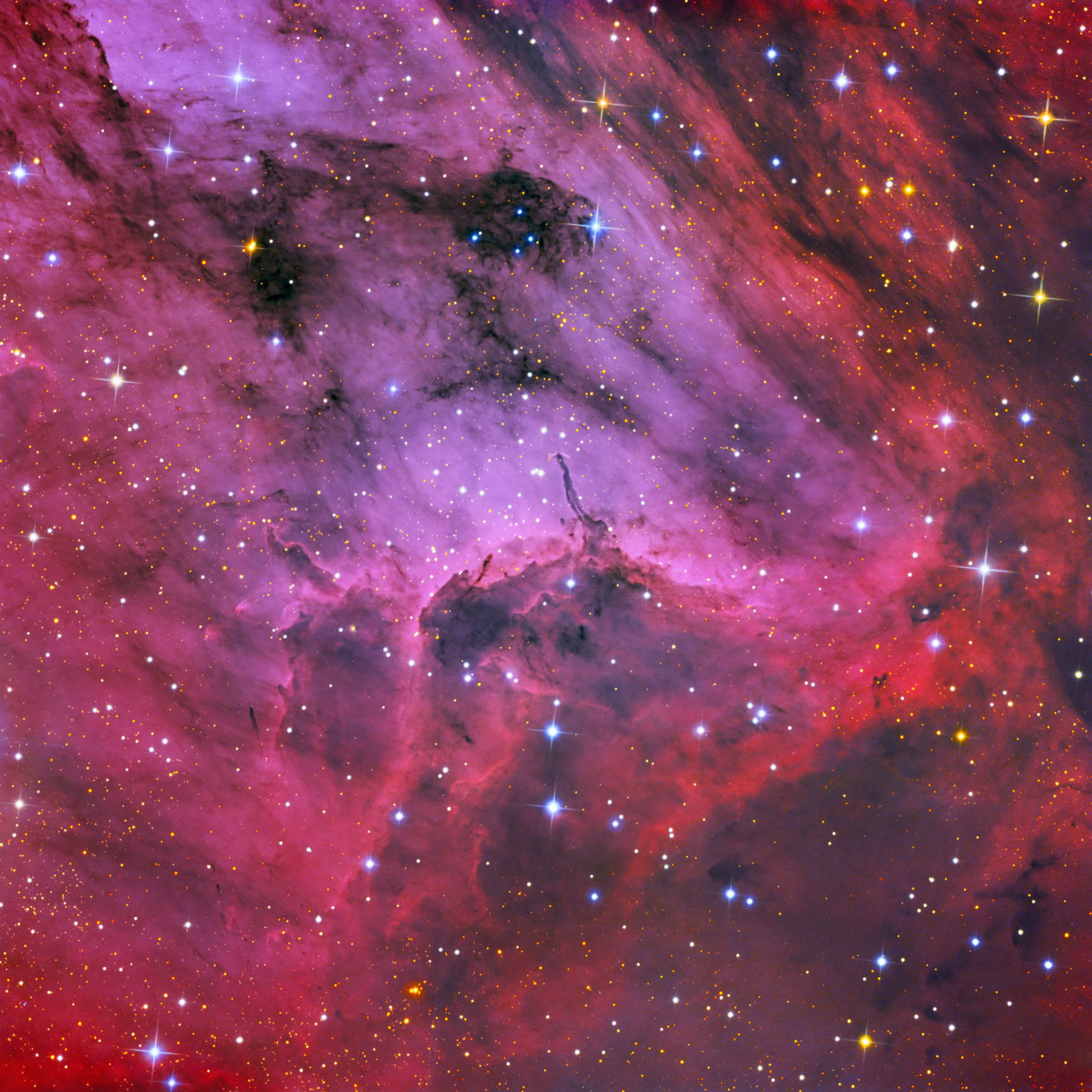
Tag: cometary globule

  • Astronomy Picture of the Day | Hole in the Sun


    Hole in the Sun
    Credit: NASA / Goddard / SDO AIA Team

    Explanation: This ominous, dark shape sprawling across the face of the Sun is a coronal hole — a low density region extending above the surface where the solar magnetic field opens freely into interplanetary space. Studied extensively from space since the 1960s in ultraviolet and x-ray light, coronal holes are known to be the source of the high-speed solar wind, atoms and electrons which flow outward along the open magnetic field lines. During periods of low activity, coronal holes typically cover regions just above the Sun’s poles. But this extensive coronal hole dominated the Sun’s northern hemisphere earlier this week, captured here in extreme ultraviolet light by cameras onboard the Solar Dynamics Observatory. The solar wind streaming from this coronal hole triggered auroral displays on planet Earth.

    via antwrp.gsfc.nasa.gov

  • Astronomy Picture of the Day | Pelican Nebula Close-up

    Pelican Nebula Close-up
    Credit & Copyright: Tony Hallas

    Explanation: The prominent ridge of emission featured in this intensely colorful skyscape is designated IC 5067. Part of a larger emission nebula with a distinctive shape, popularly called The Pelican Nebula, the ridge spans about 10 light-years and follows the curve of the cosmic pelican’s head and neck. Fantastic, dark shapes inhabiting the view are clouds of cool gas and dust sculpted by energetic radiation from hot, massive stars. But stars are also forming within the dark shapes. In fact, twin jets emerging from the tip of the central, dark tendril are the telltale signs of an embedded protostar cataloged as Herbig-Haro 555. The Pelican Nebula itself, also known as IC 5070, is about 2,000 light-years away. To find it, look northeast of bright star Deneb in the high flying constellation Cygnus.

  • Astronomy Picture of the Day | Spectacular VISTA of the Tarantula

    [Click to hugely enarachnidate, or grab the atomically-mutated, 130 Mb, 9000 x 12000 pixel megaspider version here. But be you fairly warned: you’ll lose your afternoon looking at it.]

    That is a new image of the Tarantula Nebula from the European Southern Observatory’s VISTA survey telescope in Chile. The telescope can see in the near-infrared, just outside the range of our human vision, and is being used to map a big chunk of the southern sky.

    The Tarantula is a sprawling star-forming region in the Large Magellanic Cloud, a small companion galaxy to our own Milky Way Galaxy. Of course, “small” is a matter of perspective; the LMC is still tens of thousands of light years across and has several billion stars in it. From its distance of 180,000 light years, the LMC appears as a smudge in the sky to the unaided eyes of southern observers.

    In astronomy terms the image above is huge; it covers a square degree of sky, several times the area of the full Moon! However, in real terms, if you lived in the southern hemisphere and went outside on a clear night, you could block out the entire region of the picture with the tip of one finger held at arm’s length.

    But VISTA’s 4-meter mirror has fine vision, and the image is crammed with detail. It’s hard to see in the embedded image above because it is compressed wildly to have any hope of letting y’all see it here. The higher-resolution images, however, are simply spectacular!

    And while it’s crammed with stars, gas, and dust, I didn’t pick it randomly. It has one other object in it of note: Supernova 1987A, an exploded star whose light reached us on February 23, 1987. It was, for a few shining moments, among the brightest objects in the entire Universe… but now is lost in a sea of stars, in a small section of one image of a small galaxy.

    The Tarantula Nebula is a forbidding object. It’s well over 600 light years across, has millions of times the Sun’s mass worth of gas jammed into it, and is forming stars so furiously that astronomers think it may actually be creating a globular cluster, a spherical ball of hundreds of thousands of stars. You may have heard of the Orion Nebula, one of the largest and brightest of all nebulae in the Milky Way. Well, the Tarantula is thousands of times more luminous; if it were as far away as the Orion Nebula, the Tarantula would be bright enough to cast shadows on the ground!

    VISTA will eventually map out 184 square degrees of the sky, which is truly an enormous swath of the sky at this resolution. It will guide astronomers for years to come, giving us a highly-detailed and, yes, beautiful map of stars, galaxies, and nebulae… and best of all, stuff we’re not even aware of yet. Big surveys always help us piece things together, put the details into perspective.

    But oh, sometimes, the details themselves are worth gawking at.