Tag: galaxy

  • Astronomy Picture of the Day | Hubble Observes the Large Magellanic Cloud

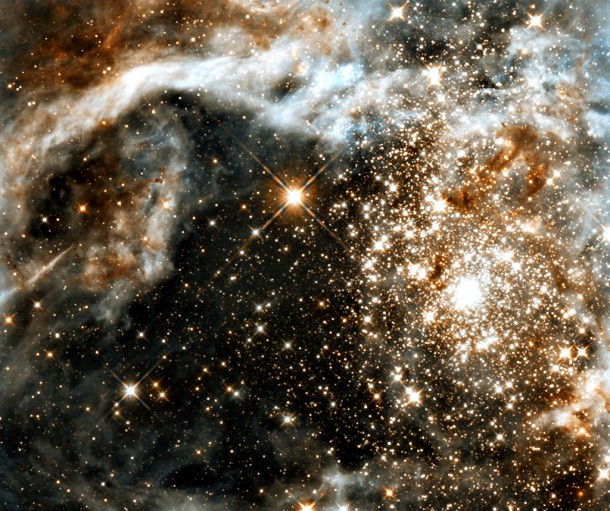
    The massive, young stellar grouping, called R136, is only a few million years old and resides in the 30 Doradus Nebula, a turbulent star-birth region in the Large Magellanic Cloud (LMC), a satellite galaxy of our Milky Way. Many of the stars are among the most massive known. Several of them are over 100 times more massive than our Sun. These hefty stars are destined to become supernovae in a few million years.
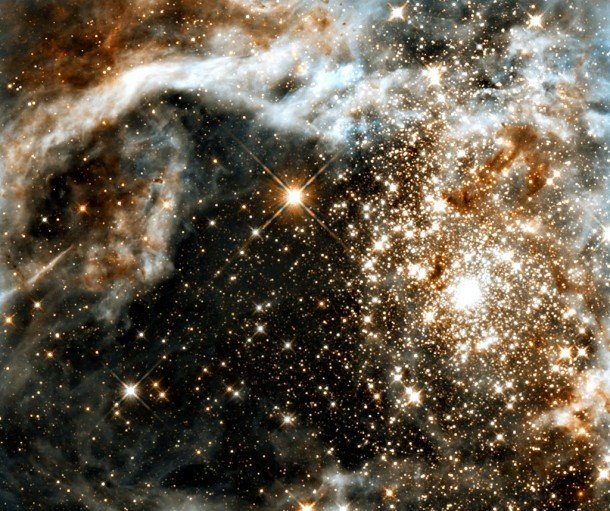
    Hubble Observes the Large Magellanic Cloud’s Star-Forming Region, 30 Doradus. Credit: NASA, ESA, and F. Paresce (INAF-IASF, Bologna, Italy)

    via spacefellowship.com

    The image, taken by Hubble’s Wide Field Camera 3, spans about 100 light-years. The nebula is close enough to Earth that Hubble can resolve individual stars, giving astronomers important information about the stars’ birth and evolution.

    The brilliant stars are carving deep cavities in the surrounding material by unleashing a torrent of ultraviolet light, and hurricane-force stellar winds (streams of charged particles), which are etching away the enveloping hydrogen gas cloud in which the stars were born. The image reveals a fantasy landscape of pillars, ridges, and valleys, as well as a dark region in the center that roughly looks like the outline of a holiday tree. Besides sculpting the gaseous terrain, the brilliant stars can also help create a successive generation of offspring. When the winds hit dense walls of gas, they create shocks, which may be generating a new wave of star birth.

    The movement of the LMC around the Milky Way may have triggered the massive cluster’s formation in several ways. The gravitational tug of the Milky Way and the companion Small Magellanic Cloud may have compressed gas in the LMC. Also, the pressure resulting from the LMC plowing through the Milky Way’s halo may have compressed gas in the satellite. The cluster is a rare, nearby example of the many super star clusters that formed in the distant, early universe, when star birth and galaxy interactions were more frequent. Previous Hubble observations have shown astronomers that super star clusters in faraway galaxies are ubiquitous. The LMC is located 170,000 light-years away and is a member of the Local Group of Galaxies, which also includes the Milky Way.

    The Hubble image was taken at infrared wavelengths (1.1 microns and 1.6 microns). Hubble sees through the dusty nebula, revealing many stars that cannot be seen in visible light. The large bright star just above the center of the image is in the 30 Doradus nebula. The Hubble observations of 30 Doradus were made October 20-27, 2009.

    Posted via web from Monicks: Unleashed

  • Hubble Pictures of the Week

    IC4634’s Glowing Waves

    This striking Hubble image of the planetary nebula IC 4634 reveals two shining, S-shaped ejections from a dying star. This star, awash in glowing material at the centre of the picture, bloated as it aged and launched its outer layers off into space. The star’s very hot, exposed core has since beamed intense ultraviolet radiation at these lost shells of gas, making them glow in rich colours.

    This process has been far from orderly or calm, however, as revealed by the distinct, separate waves of thrown-off gases. One is more distant and therefore was spewed first, followed by a more recently ejected tide of matter that formed the tighter S-shape. The result is remarkably symmetric on each side of the central star.

    The NASA/ESA Hubble Space Telescope’s Wide Field Planetary Camera 2 (WFPC2) captured this image of IC 4634, which is found more than about 7500 light-years away in the constellation of Ophiuchus (the Serpent Holder). IC 4634 and other objects like it are known as planetary nebulae due to their appearance through early telescopes as rounded, faintly luminous discs similar to the distant planets Uranus and Neptune. The picture was created from images through five different filters (F487N, F502N, F574M, F656N and F658N) that captured light emitted by different elements in the gaseous features. The total aggregate exposure time was 4000 seconds and the field of view is just 29 arcseconds across.

    A Clump of Galaxy Misfits

    That galaxies come in very different shapes and sizes is dramatically demonstrated by this striking Hubble image of the Hickson Compact Group 59. Named by astronomer Paul Hickson in 1982, this is the 59th such collection of galaxies in his catalogue of unusually close groups. What makes this image interesting is the variety on display. There are two large spiral galaxies, one face-on with smooth arms and delicate dust tendrils, and one highly inclined, as well as a strangely disorderly galaxy featuring clumps of blue young stars. We can also see many apparently smaller, probably more distant, galaxies visible in the background. Hickson groups display many peculiarities, often emitting in the radio and infrared and featuring active star-forming regions. In addition their galaxies frequently contain Active Galactic Nuclei powered by supermassive black holes, as well large quantities of dark matter.

    The NASA/ESA Hubble Space Telescope’s Advanced Camera for Surveys, using the Wide Field Channel, captured this image of HCG059 in 2007. The picture was created from images taken through blue, yellow and near-infrared filters (F435W, F606W and F814W). The total exposure times per filter were 57 minutes, 41 minutes and 35 minutes respectively. The field of view is about 3.4 arcminutes across.

    Credit: ESA/Hubble and NASA

    Posted via web from Monicks: Unleashed

  • Star: om nom nom! Planet: Aieee!

    600 light years away, in the constellation of Auriga, there is a star in some ways similar to our Sun. It’s a shade hotter (by about 800° C), more massive, and older. Oddly, it appears to be laced with heavy elements: more oxygen, aluminum, and so on, than might be expected. A puzzle.

    The, last year, it was discovered that this star had a planet orbiting it. A project called WASP – Wide Area Search for Planets, a UK telescope system that searches for exoplanets — noticed that the star underwent periodic dips in its light. This indicates that a planet circles the star, and when the planet gets between the star and us, it blocks a tiny fraction of the starlight.

    The planet is a weirdo, for many reasons… but it won’t be weird for too much longer. That’s because the star is eating it.

    What WASP 12b may look like

    What WASP 12b may look like.

    OK, first, the planet. Called WASP 12b, it was instantly pegged as an oddball. The orbit is only 1.1 days long! Compare that to our own 365 day orbit, or even Mercury’s 88 days to circle the Sun. This incredibly short orbital period means this planet is practically touching the surface of its star as it sweeps around at over 220 km/sec (130 miles/sec)! That also means it must be very hot; models indicate that the temperature at its cloud tops would be in excess of 2200°C (4000° F).

    Not only that, but other numbers were odd, too. WASP 12b was found to be a bit more massive and bigger than Jupiter; about 1.8 times its size and 1.4 times its mass. That’s too big! Models indicate that planets this massive have a funny state of matter in them; they are so compressible that if you add mass, the planet doesn’t really get bigger, it just gets denser. In other words, you could double Jupiter’s mass and its size wouldn’t increase appreciably, but since the mass goes up, so would its density.

    But WASP 12b isn’t like that. In fact, it has a lower density than Jupiter, and is a lot bigger! Something must be going on… and when you see a lot of weird things all sitting in one place, it makes sense to assume they’re connected. In this case it’s true: that planet is frakking hot, and that’s at the heart of this mess. Heating a planet that much would not exactly be conducive to its well-being. When you heat a gas it expands, which would explain WASP 12b’s big size. It’s puffy! But being all bloated that close to a star turns out to be bad for your health.

    Astronomers used Hubble to observe the planet in the ultraviolet and found clear signs of all sorts of heavy elements, including sodium, tin, aluminum, magnesium, and manganese, as well as, weirdly, ytterbium*. Moreover, they could tell from the data that these elements existed in a cloud surrounding the planet, like an extended atmosphere going outward for hundreds of thousands of kilometers.

    That’s a long way from the planet. Any atom of, say, manganese that far from the planet would be caught in a tug-of-war between the gravity of the planet and the star… and the star would win. The gravity of the star is drawing material off the planet in a vast stream, or, in other words, the planet is getting slowly eaten by its star. If astronomers ever get around to giving this planet an actual name, I suggest Sarlacc.

    This explains the peculiar high abundance of heavy metals in the star I mentioned at the beginning of this post; they come from the planet! But not for long. Given the mass of the planet and the density of the stream, it looks like it has roughly ten million years left. At that point, supper’s over: there won’t be anything left for the star to eat. In reality it’s hard to say exactly what will happen; there may be a rocky/metal core to the planet that will survive. But even that is so close to the star that it will be a molten blob of goo. The way orbits work, the way the dance of gravity plays out over time, the planet itself may actually be drawn inexorably closer to its star. Remember, too, the star is old, and will soon start to expand into a red giant. So the planet is falling and the star is rising; eventually the too will meet and the planet will meet a fiery death.

    All in all, it sucks to be WASP 12b.

    But it’s cool to be an astronomer! Only 15 years ago we had no idea that there were other planets orbiting Sunlike stars, and now we know of over 400, and a lot of them are really, really bizarro. When I was a kid I watched Star Trek and read a lot of science fiction, and I remember thinking that the planets in them were too weird; there was no way anything like them could actually exist.

    Ha! The Universe, as usual, is smarter and more clever than we are. There’s a lot of strange out there, and the more we look, the more we find.


    * Admit it: you didn’t even know that was an element.

    Posted via web from Monicks: Unleashed