Tag: galaxy

  • Astronomy Picture of the Day | The Dark Tower in Scorpius

    Image Credit & Copyright: Thomas V. Davis

    This object is an obscure cometary globule in Scorpius. I think the name came from John Gleason who imaged it in h-alpha. Actually only a few images of it exist, all I believe taken in h-alpha except for David Malin’s color film version. Its a cool target and seems to be the southern hemisphere’s equivalent to Vdb 142 (IC1396A). I hope you enjoy it.

    Bright rimmed globules and their more evolved cousin the cometary globule represent fascinating dynamic structures formed by the interplay of cold molecular clouds and hot ionizing stars. Typically the head of the globule faces a hot O-type star. Intense radiation from the star boils away lower density gas from the head. The evaporated rim of gas becomes ionized by the stars ultraviolet flux forming a bright glowing rim we associate with many of these globules including CG4. Intense stellar winds from the ionizing star evaporate gas and dust away from the head forming the “tail” and completing the cometary shape. The globules are known to be the birthplace of low mass stars. Stars form within the globules by the mechanism known as “radiation driven implosion”. This process occurs when ultraviolet flux from a hot star compresses surviving clumps of cold molecular gas eventually causing collapse and core formation within the dense compact clouds. Lower and intermediate mass stars ultimately form from the compact gas and dust within the globules.

    In silhouette against a crowded star field toward the constellation Scorpius, this dusty cosmic cloud evokes for some the image of an ominous dark tower. In fact, clumps of dust and molecular gas collapsing to form stars may well lurk within the dark nebula, a structure that spans almost 40 light-years across the gorgeous telescopic view. Known as a cometary globule, the swept-back cloud, extending from the lower left to the head (top of the tower) right and above center, is shaped by intense ultraviolet radiation from the OB association of very hot stars in NGC 6231, off the right edge of the scene. That energetic ultraviolet light also powers the globule’s bordering reddish glow of hydrogen gas. Hot stars embedded in the dust can be seen as bluish reflection nebulae. This dark tower, NGC 6231, and associated nebulae are about 5,000 light-years away.

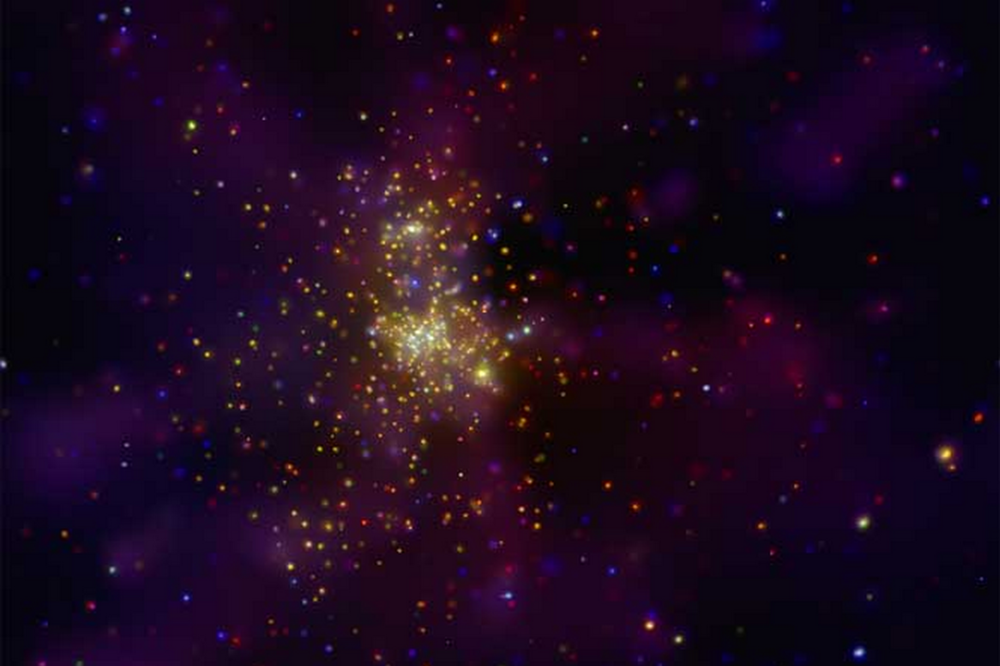
  • Astronomy Picture of the Day | Westerlund 2

    Image credit: NASA/CXC/Univ. de Liege/Y. Nael et al.

    This Chandra X-ray Observatory image shows Westerlund 2, a young star cluster with an estimated age of about one or two million years. Until recently little was known about this cluster because it is heavily obscured by dust and gas. However, using infrared and X-ray observations to overcome this obscuration, Westerlund 2 has become regarded as one of the most interesting star clusters in the Milky Way galaxy. It contains some of the hottest, brightest and most massive stars known.

    This Chandra image of Westerlund 2 shows low energy X-rays in red, intermediate energy X-rays in green and high energy X-rays in blue. The image shows a very high density of massive stars that are bright in X-rays, plus diffuse X-ray emission.

    An incredibly massive double star system called WR20a is visible as the bright yellow point just below and to the right of the cluster’s center. This system contains stars with masses of 82 and 83 times that of the Sun. The dense streams of matter steadily ejected by these two massive stars, called stellar winds, collide with each other and produce copious amounts of X-ray emission. This collision is seen at different angles as the stars orbit around each other every 3.7 days. Several other bright X-ray sources may also show evidence for collisions between winds in massive binary systems.

  • Astronomy Picture of the Day | Hubble snaps heavyweight of the Leo Triplet

    Credit: NASAESA and the Hubble Heritage (STScI/AURA)-ESA/Hubble Collaboration. Acknowledgement: Davide De Martin and Robert Gendler

    Hubble has snapped a spectacular view of M 66, the largest “player” of the Leo Triplet, and a galaxy with an unusual anatomy: it displays asymmetric spiral arms and an apparently displaced core. The peculiar anatomy is most likely caused by the gravitational pull of the other two members of the trio.

    Those three galaxies are close enough together that the gravity of each affects the other two. See how the spiral arm at the bottom appears to be wider, messier, less organized than the one near the top of the picture? That’s no illusion. It’s thought that a recent pass by NGC 3628 may have bonked M66 pretty hard, disturbing it and messing around with its structure. The core of the galaxy — usually a smooth and symmetric blob — is all weird and misshapen. The pink glow in the image (emitted by hydrogen gas) is where stars are being born, and the deeper red is where they’re being cranked out en masse. Many times, when a galaxy passes near another one, the gas clouds get all riled up, collapsing to form lots of new stars.

    That’s more obvious in the Spitzer Space Telescope image included here. Spitzer sees far-infrared light, which is emitted by warm gas and dust. You can see how wide and weird the lower spiral arm of M66 is, as if it’s been tugged and pulled, like a piece of taffy.

    In this Spitzer image, gas and dust emission is also colored red, and starlight is blue (seen as a fuzzy glow since individual stars are not visible). You can see the stars are not distributed evenly: instead there’s more to the right; a good sign that another galaxy is affecting M66. Also, since red is gas and dust, that’s where stars are being actively born, and there’s a lot of that going on just outside the central region of the galaxy. That’s yet another sign that this galaxy was disturbed; the gravity of a passing galaxy can push the gas toward the center where it circles the core and forms stars.

    And the clincher? In most galaxies, you see one star exploding at the end of its life every century or so. In the past 20 years, M66 has had three! Hot, massive stars don’t live long, only a few million years. So if a galaxy is making more stars than usual, you’ll see more supernovae than usual. Clearly, M66 has been pretty busy lately!

    The unusual spiral galaxy, Messier 66, is located at a distance of about 35 million light-years in the constellation of Leo. Together with Messier 65 and NGC 3628, Messier 66 is the member of the Leo Triplet, a trio of interacting spiral galaxies, part of the larger Messier 66 group. Messier 66 wins in size over its fellow triplets — it is about 100 000 light-years across.

    This is a composite of images obtained through the following filters: 814W (near infrared), 555W (green) and H-alpha (showing the glowing of the hydrogen gas). They have been combined so to represent the real colours of the galaxy.