Tag: hubble
-
Backwards Black Holes Might Make Bigger Jets
PASADENA, Calif. – Going against the grain may turn out to be a powerful move for black holes. New research suggests supermassive black holes that spin backwards might produce more ferocious jets of gas. The results have broad implications for how galaxies change over time.
“A lot of what happens in an entire galaxy depends on what’s going on in the miniscule central region where the black hole lies,” said theoretical astrophysicist David Garofalo of NASA’s Jet Propulsion Laboratory in Pasadena, Calif. Garofalo is lead author of a new paper that appeared online May 27 in the Monthly Notices of the Royal Astronomical Society. Other authors are Daniel A. Evans of the Massachusetts Institute of Technology, Cambridge, Mass., and Rita M. Sambruna of NASA Goddard Space Flight Center, Greenbelt, Md.
Black holes are immense distortions of space and time with gravity that is so great, even light itself cannot escape. Astronomers have known for more than a decade that all galaxies, including our own Milky Way, are anchored by tremendous, so-called supermassive black holes, containing billions of suns’ worth of mass. The black holes are surrounded and nourished by disks of gas and dust, called accretion disks. Powerful jets stream out from below and above the disks like lasers, and fierce winds blow off from the disks themselves.
The black holes can spin either in the same direction as the disks, called prograde black holes, or against the flow – the retrograde black holes. For decades, astronomers thought that the faster the spin of the black hole, the more powerful the jet. But there were problems with this “spin paradigm” model. For example, some prograde black holes had been found with no jets.
Garofalo and his colleagues have been busy flipping the model on its head. In previous papers, they proposed that the backward, or retrograde, black holes spew the most powerful jets, while the prograde black holes have weaker or no jets.
The new study links the researchers’ theory with observations of galaxies across time, or at varying distances from Earth. They looked at both “radio-loud” galaxies with jets, and “radio-quiet” ones with weak or no jets. The term “radio” comes from the fact that these particular jets shoot out beams of light mostly in the form of radio waves.
The results showed that more distant radio-loud galaxies are powered by retrograde black holes, while relatively closer radio-quiet objects have prograde black holes. According to the team, the supermassive black holes evolve over time from a retrograde to a prograde state.
“This new model also solves a paradox in the old spin paradigm,” said David Meier, a theoretical astrophysicist at JPL not involved in the study. “Everything now fits nicely into place.”
The scientists say that the backward black holes shoot more powerful jets because there’s more space between the black hole and the inner edge of the orbiting disk. This gap provides more room for the build-up of magnetic fields, which fuel the jets, an idea known as the Reynold’s conjecture after the theoretical astrophysicist Chris Reynolds of the University of Maryland, College Park.
“If you picture yourself trying to get closer to a fan, you can imagine that moving in the same rotational direction as the fan would make things easier,” said Garofalo. “The same principle applies to these black holes. The material orbiting around them in a disk will get closer to the ones that are spinning in the same direction versus the ones spinning the opposite way.”
Jets and winds play key roles in shaping the fate of galaxies. Some research shows that jets can slow and even prevent the formation of stars not just in a host galaxy itself, but also in other nearby galaxies.
“Jets transport huge amounts of energy to the outskirts of galaxies, displace large volumes of the intergalactic gas, and act as feedback agents between the galaxy’s very center and the large-scale environment,” said Sambruna. “Understanding their origin is of paramount interest in modern astrophysics.”
The California Institute of Technology, Pasadena, manages JPL for NASA.
-
As the Sun Awakens, NASA Keeps a Wary Eye on Space Weather
Earth and space are about to come into contact in a way that’s new to human history. To make preparations, authorities in Washington DC are holding a meeting: The Space Weather Enterprise Forum at the National Press Club on June 8th.
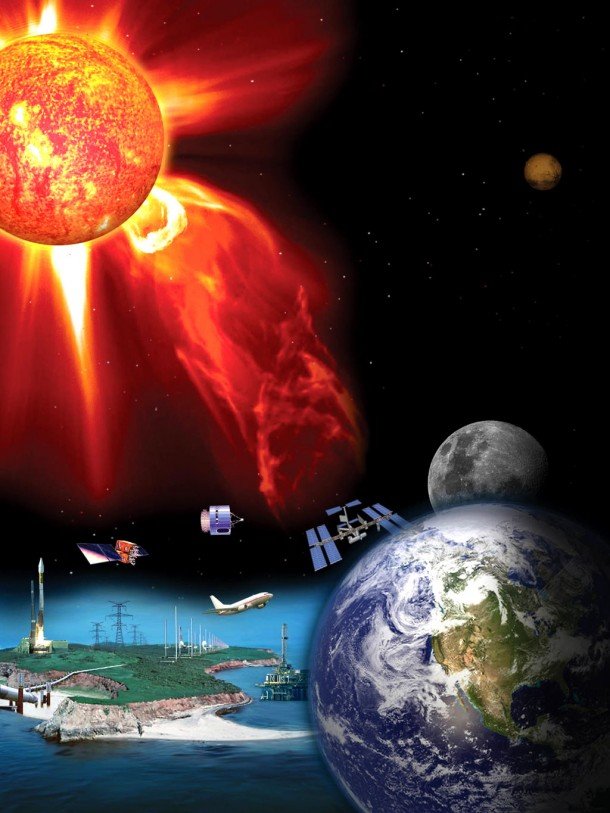
Many technologies of the 21st century are vulnerable to solar storms. Credit: NASA
Richard Fisher, head of NASA’s Heliophysics Division, explains what it’s all about:
“The sun is waking up from a deep slumber, and in the next few years we expect to see much higher levels of solar activity. At the same time, our technological society has developed an unprecedented sensitivity to solar storms. The intersection of these two issues is what we’re getting together to discuss.”
The National Academy of Sciences framed the problem two years ago in a landmark report entitled “Severe Space Weather Events—Societal and Economic Impacts.” It noted how people of the 21st-century rely on high-tech systems for the basics of daily life. Smart power grids, GPS navigation, air travel, financial services and emergency radio communications can all be knocked out by intense solar activity. A century-class solar storm, the Academy warned, could cause twenty times more economic damage than Hurricane Katrina.
Much of the damage can be mitigated if managers know a storm is coming. Putting satellites in ’safe mode’ and disconnecting transformers can protect these assets from damaging electrical surges. Preventative action, however, requires accurate forecasting—a job that has been assigned to NOAA.
“Space weather forecasting is still in its infancy, but we’re making rapid progress,” says Thomas Bogdan, director of NOAA’s Space Weather Prediction Center in Boulder, Colorado.
Bogdan sees the collaboration between NASA and NOAA as key. “NASA’s fleet of heliophysics research spacecraft provides us with up-to-the-minute information about what’s happening on the sun. They are an important complement to our own GOES and POES satellites, which focus more on the near-Earth environment.”
[youtube=http://www.youtube.com/watch?v=Ctjb-f75PkY]
Among dozens of NASA spacecraft, he notes three of special significance: STEREO, SDO and ACE.
STEREO (Solar Terrestrial Relations Observatory) is a pair of spacecraft stationed on opposite sides of the sun with a combined view of 90% of the stellar surface. In the past, active sunspots could hide out on the sun’s farside, invisible from Earth, and then suddenly emerge over the limb spitting flares and CMEs. STEREO makes such surprise attacks impossible.
SDO (the Solar Dynamics Observatory) is the newest addition to NASA’s fleet. Just launched in February, it is able to photograph solar active regions with unprecedented spectral, temporal and spatial resolution. Researchers can now study eruptions in exquisite detail, raising hopes that they will learn how flares work and how to predict them. SDO also monitors the sun’s extreme UV output, which controls the response of Earth’s atmosphere to solar variability.
Bogdan’s favorite NASA satellite, however, is an old one: the Advanced Composition Explorer (ACE) launched in 1997. “Where would we be without it?” he wonders. ACE is a solar wind monitor. It sits upstream between the sun and Earth, detecting solar wind gusts, billion-ton CMEs, and radiation storms as much as 30 minutes before they hit our planet.
“ACE is our best early warning system,” says Bogdan. “It allows us to notify utility and satellite operators when a storm is about to hit.”
NASA spacecraft were not originally intended for operational forecasting—”but it turns out that our data have practical economic and civil uses,” notes Fisher. “This is a good example of space science supporting modern society.”
2010 marks the 4th year in a row that policymakers, researchers, legislators and reporters have gathered in Washington DC to share ideas about space weather. This year, forum organizers plan to sharpen the focus on critical infrastructure protection. The ultimate goal is to improve the nation’s ability to prepare, mitigate, and respond to potentially devastating space weather events.
“I believe we’re on the threshold of a new era in which space weather can be as influential in our daily lives as ordinary terrestrial weather.” Fisher concludes. “We take this very seriously indeed.”