Tag: hubble

  • Astronomy Picture of the Day – Scattered Light from the Boomerang Nebula

    The Hubble Space Telescope caught the Boomerang Nebula in this image taken with the Advanced Camera for Surveys in early 2005. This reflecting cloud of dust and gas has two nearly symmetric lobes of matter that are being ejected from a central star.

    Hubble Catches Scattered Light from the Boomerang Nebula. Credit: NASA, ESA and The Hubble Heritage Team STScI/AURA)

    Each lobe of the nebula is nearly one light-year in length, making the total length of the nebula half as long as the distance from our Sun to our nearest neighbors – the alpha Centauri stellar system, located roughly 4 light-years away. The Boomerang Nebula resides 5,000 light-years from Earth. Hubble’s sharp view is able to resolve patterns and ripples in the nebula very close to the central star that are not visible from the ground.

  • NASA’s Swift Survey finds ‘Smoking Gun’ of Black Hole Activation

    Data from an ongoing survey by NASA’s Swift satellite have helped astronomers solve a decades-long mystery about why a small percentage of black holes emit vast amounts of energy.

    These images show the optical counterparts of several AGN detected by the Swift BAT Hard X-ray Survey. The galaxy shapes are either physically intertwined or distorted by the gravity of nearby neighbors. The active black holes (circled) were known prior to the Swift survey, but Swift has found dozens of new AGN in more distant galaxies. Credit: NASA/Swift/NOAO/Michael Koss and Richard Mushotzky (Univ. of Maryland)

    Only about one percent of supermassive black holes exhibit this behavior. The new findings confirm that black holes “light up” when galaxies collide, and the data may offer insight into the future behavior of the black hole in our own Milky Way galaxy. The study will appear in the June 20 issue of The Astrophysical Journal Letters.

    The intense emission from galaxy centers, or nuclei, arises near a supermassive black hole containing between a million and a billion times the sun’s mass. Giving off as much as 10 billion times the sun’s energy, some of these active galactic nuclei (AGN) are the most luminous objects in the universe. They include quasars and blazars.

    “Theorists have shown that the violence in galaxy mergers can feed a galaxy’s central black hole,” said Michael Koss, the study’s lead author and a graduate student at the University of Maryland in College Park. “The study elegantly explains how the black holes switched on.”

    Until Swift’s hard X-ray survey, astronomers never could be sure they had counted the majority of the AGN. Thick clouds of dust and gas surround the black hole in an active galaxy, which can block ultraviolet, optical and low-energy, or soft X-ray, light. Infrared radiation from warm dust near the black hole can pass through the material, but it can be confused with emissions from the galaxy’s star-forming regions. Hard X-rays can help scientists directly detect the energetic black hole.

    Since 2004, the Burst Alert Telescope (BAT) aboard Swift has been mapping the sky using hard X-rays.

    Posted via web from Monicks: Unleashed

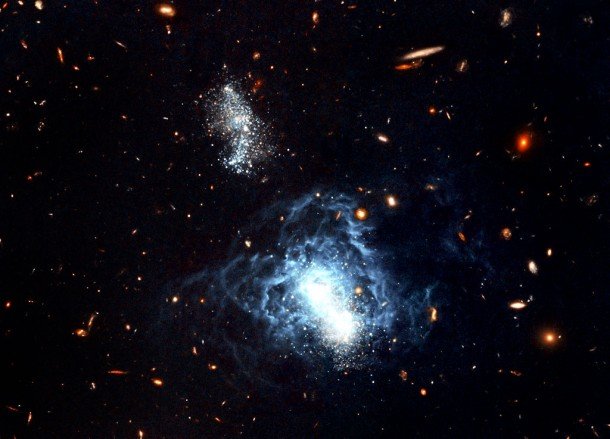
  • Astronomy Picture of the Day – Mature Galaxy Masquerading as Toddler

    The Hubble Space Telescope quashed the possibility that what was previously believed to be a toddler galaxy in the nearby universe may actually be considered an adult. Called I Zwicky 18, this galaxy has a youthful appearance that resembles galaxies typically found only in the early universe. Hubble has now found faint, older stars within this galaxy, suggesting that the galaxy may have formed at the same time as most other galaxies.

    Hubble Finds Mature Galaxy Masquerading as Toddler. Credit: NASA, ESA, and A. Aloisi (European Space Agency and Space Telescope Science Institute)

    I Zwicky 18 is classified as a dwarf irregular galaxy and is much smaller than our Milky Way Galaxy. The concentrated bluish-white knots embedded in the heart of the galaxy are two major starburst regions where stars are forming at a furious rate. The wispy blue filaments surrounding the central starburst regions are bubbles of gas that have been blown away by stellar winds and supernovae explosions from a previous generation of hot, young stars. This gas is now heated by intense ultraviolet radiation unleashed by hot, young stars.

    A companion galaxy lies just above and to the left of I Zwicky 18. The companion may be interacting with I Zwicky 18 by gravitationally tugging on the galaxy. The interaction may have triggered the galaxy’s recent star formation that is responsible for the youthful appearance. Besides the bluish-white young stars, white-reddish stars also are visible in both I Zwicky 18 and its companion. These stars may be as old as 10 billion years. The reddish extended objects surrounding I Zwicky 18 and its companion are ancient, fully formed galaxies of different shapes that are much farther away.

    Hubble data also allowed astronomers for the first time to identify Cepheid variable stars in I Zwicky 18. These flashing stellar mile-markers were used to determine that I Zwicky 18 is 59 million light-years from Earth, almost 10 million light-years more distant than previously believed.

    The observations of I Zwicky 18 were taken in 2005 and 2006 with Hubble’s Advanced Camera for Surveys. Astronomers made this image by combining observations taken with blue and red filters.

    The science team consists of Alessandra Aloisi and Marco Sirianni of the European Space Agency and Space Telescope Science Institute; Francesca Annibali,Jennifer Mack, and Roeland van der Marel of the Space Telescope Science Institute; Abhijit Saha of the National Optical Astronomy Observatories; and Gisella Clementini, Rodrigo Contreras, Giuliana Fiorentino, Marcella Marconi, Ilaria Musella, and Monica Tosi of the Italian National Astrophysics Institutes in Bologna and Naples.