Tag: hubble

  • Astronomy Picture of the Day | Tycho’s Supernova Remnant

    This composite image of the Tycho supernova remnant combines infrared and X-ray observations obtained with the Spitzer and Chandra space observatories and the Calar Alto observatory. It shows the scene more than 4 centuries after the brilliant explosion witnessed by Tycho Brahe and other contemporary astronomers as “Stella Nova”. The thermonuclear explosion of the white dwarf star has left a several million degree hot cloud of expanding debris (green, yellow). The location of the blast’s outer shock wave can be seen as blue sphere of ultra-energetic electrons. Newly synthesized dust in the ejecta as well as heated pre-existing dust from the circumstellar medium of the supernova radiates at a wavelength of 24 micron (red). Fore- and background star in the image are white. Observers were Prof. John P. Hughes, Dr. Jeonghee Rho and Dr. Oliver Krause.

  • Astronomy Picture of the Day | Spiral Galaxy IC342

    ic342-1000

    Spiral Galaxy IC342 is located roughly 11 million light-years from Earth in the constellation Camelopardalis, “the giraffe.” Its face-on appearance in the sky—as opposed to our tilted and edge-on views of many other nearby galaxies, such as the large spiral galaxy Andromeda (M31)—makes IC342 a prime target for studies of star formation and astrochemistry.

    The image, obtained in late 2006, was taken using the 64-megapixel Mosaic-1 digital imager on the Mayall 4-meter telescope. This image is the subject of NOAO press release 07-03

  • Astronomy Picture of the Day | A Giant Planet for Beta Pic

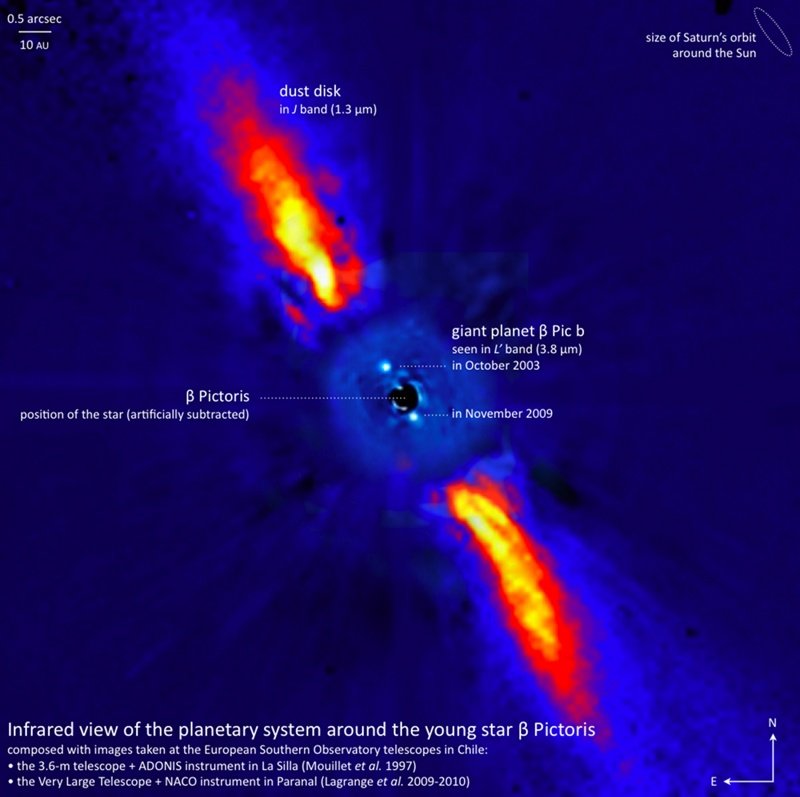
    A Giant Planet for Beta Pic
    Credit: A.-M. Lagrange, D. Ehrenreich (LAOG), et al., ESO

    Explanation: A mere 50 light-years away, young star Beta Pictoris became one of the most important stars in the sky in the early 1980s. Satellite and ground-based telescopic observations revealed the presence of a surrounding outer, dusty, debris disk and an inner clear zone about the size of our solar system — strong evidence for the formation of planets. Infrared observations from European Southern Observatory telescopes subsequently detected a source in the clear zone, now confirmed as a giant planet orbiting Beta Pic. The confirmation comes as the planet is detected at two different positions in its orbit. Designated Beta Pictoris b, the giant planet must have formed rapidly as Beta Pic itself is only 8 to 20 million years old. With an orbital period estimated between 17 and 44 years, Beta Pictoris b could lie near the orbit of Saturn if found in our solar system, making it the closest planet to its parent star directly imaged … so far.