[youtube=http://www.youtube.com/watch?v=l7AWnfFRc7g]
Bestselling author, political adviser and social and ethical prophet Jeremy Rifkin investigates the evolution of empathy and the profound ways that it has shaped our development and our society.
[youtube=http://www.youtube.com/watch?v=l7AWnfFRc7g]
Bestselling author, political adviser and social and ethical prophet Jeremy Rifkin investigates the evolution of empathy and the profound ways that it has shaped our development and our society.
GRO J1655-40: Evidence for a Spinning Black Hole
Credit: April Hobart, CXC
Explanation: In the center of a swirling whirlpool of hot gas is likely a beast that has never been seen directly: a black hole. Studies of the bright light emitted by the swirling gas frequently indicate not only that a black hole is present, but also likely attributes. The gas surrounding GRO J1655-40, for example, has been found to display an unusual flickering at a rate of 450 times a second. Given a previous mass estimate for the central object of seven times the mass of our Sun, the rate of the fast flickering can be explained by a black hole that is rotating very rapidly. What physical mechanisms actually cause the flickering — and a slower quasi-periodic oscillation (QPO) — in accretion disks surrounding black holes and neutron stars remains a topic of much research.
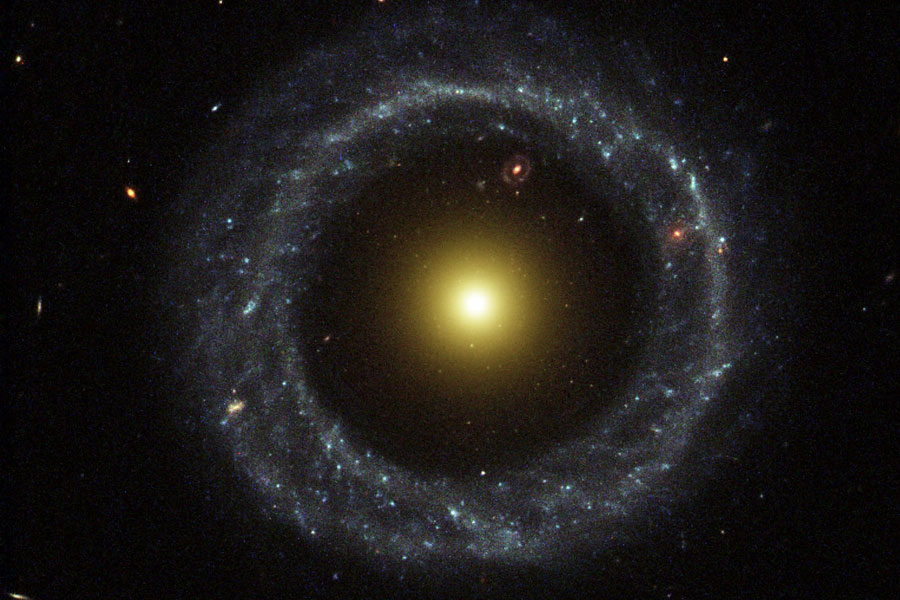
Hoag’s Object: A Strange Ring Galaxy
Credit: R. Lucas (STScI/AURA), Hubble Heritage Team, NASA
Explanation: Is this one galaxy or two? This question came to light in 1950 when astronomer Art Hoag chanced upon this unusual extragalactic object. On the outside is a ring dominated by bright blue stars, while near the center lies a ball of much redder stars that are likely much older. Between the two is a gap that appears almost completely dark. How Hoag’s Object formed remains unknown, although similar objects have now been identified and collectively labeled as a form of ring galaxy. Genesis hypotheses include a www.ipac.caltech.edu/level5/Struck/frames.html“>galaxy collision billions of years ago and the gravitational effect of a central bar that has since vanished. The above photo taken by the Hubble Space Telescope in July 2001 reveals unprecedented details of Hoag’s Object and may yield a www.ipac.caltech.edu/level5/Rings/Rings17_2.html“>better understanding. Hoag’s Object spans about 100,000 light years and lies about 600 million light years away toward the constellation of the Snake (Serpens). Coincidentally, visible in the gap (at about one o’clock) is yet another ring galaxy that likely lies far in the distance.