Tag: Science

  • The Think Atheist Seed Project

    How sweet it is to have free web hosting!

    The Think Atheist Seed Project is a service provided by The Think Atheist Foundation, to the Atheist and Agnostic blogging community to help them grow and get the word out.

    So, I have moved to a new home, I thought I should let you guys know that I will be no longer updating this blog.

    Those of you who have kindly subscribed to this humble feed, and still enjoy checking these posts, are more than welcome to subscribe to the new Monicks.net.

    If you are an active blogger, by all means, check out the The Think Atheist Seed Project site, and see if you’re elegible for this benefit.

    If you have any questions regarding The Think Atheist Seed Project rules, don’t hesitate to contact me. My contact info is right there.➙

    Thank you for all your visits and comments, I hope to see you all at my new home, that is also yours. ♥

  • Gliese 581g – The next “Earth”?

    [youtube=http://www.youtube.com/watch?v=M6_HooIJLNc]
    The fact that we’ve found a habitable planet candidate so soon after starting our search has important implications for the number of habitable planets that may exist in our galaxy – which was estimated to be around 10 billion. 

    Having found Gliese 581g so soon though, may mean one of two things. Either we were very lucky, or there are more planets out there than we thought. Based on this discovery, it’s possible that we may have many more habitable planets than originally thought.

    Perhaps 20 to 30 billion stars in our galaxy may have conditions suitable for life.

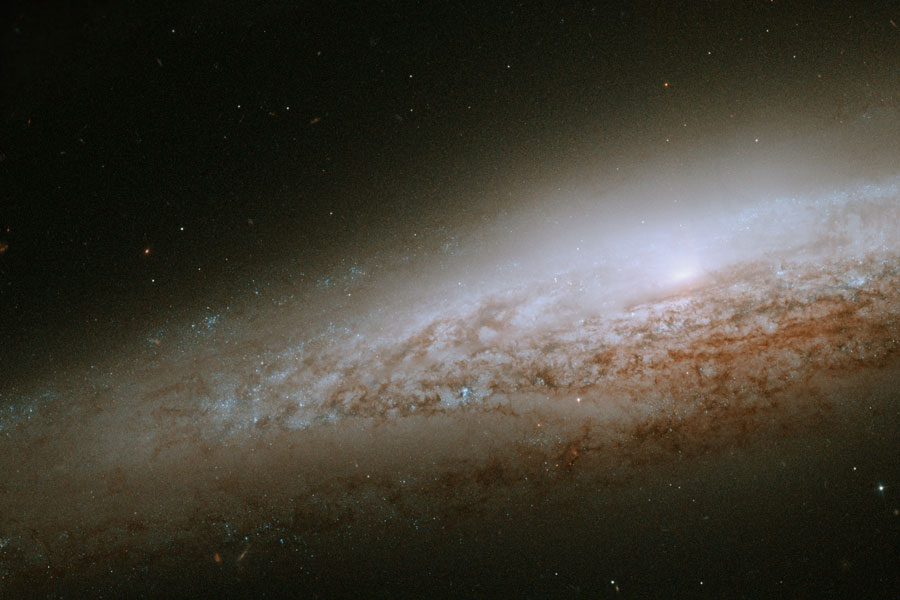
  • Astronomy Picture Of The Day | NGC 2683: Spiral Edge-On

    NGC 2683: Spiral Edge-On

    Credit: Data: Hubble Legacy Archive, ESA, NASA; Processing: Nikolaus Sulzenauer

    Explanation: Does spiral galaxy NGC 2683 have a bar across its center? Being so nearly like our own barred Milky Way Galaxy, one might guess it has. Being so nearly edge-on, however, it is hard to tell. Either way, this gorgeous island universe, cataloged as NGC 2683, lies a mere 20 million light-years distant in the northern constellation of the Cat (Lynx). NGC 2683 is seen nearly edge-on in this cosmic vista, with more distant galaxies scattered in the background. Blended light from a large population of old yellowish stars forms the remarkably bright galactic core. Starlight silhouettes the dust lanes along winding spiral arms, dotted with the telltale blue glow of young star clusters in this galaxy‘s star forming regions.

    NGC 2683 was discovered by William Herschel on February 5, 1788.

    This spiral galaxy is viewed nearly edge-on from our perspective. Because of its appearance, it was nicknamed the “UFO Galaxy” by the Astronaut Memorial Planetarium and Observatory site. Note the small yellowish core in the center of the galaxy, consisting of older stars. Also note the fine details of the spiral structure, traced by dark dust in the brighter part of the disk (particularly well visible in the larger image.

    The UFO is receding from us at 410 km/s, and from the Galactic Center at 375 km/s. This indicates that it is probably one of the nearby galaxies, perhaps at about 16 million light years.

    The image in this page was obtained by Dick Stone when participating in the Kitt Peak Visitor Center’s Advanced Observing Program. It is a composite of 4 CCD images: Luminance = 42 min, Red = 20 min, Green = 20 min, Blue = 40 min.

    via apod.nasa.gov