
Tag: stars

  • A Universe From Nothing

    [youtube=http://www.youtube.com/watch?v=7ImvlS8PLIo]

    Lawrence Krauss at the Atheist Alliance International 2009, gives a talk on our current picture of the universe, how it will end, and how it could have come from nothing. Krauss is the author of many bestselling books on Physics and Cosmology, including “The Physics of Star Trek.”

    This is, by far, the best talk I’ve had the pleasure to listen to. It is a bit long so, if you don’t have much time to listen to the whole talk now, at least listen to this excerpt, it’s just one minute long.

    [youtube=http://www.youtube.com/watch?v=VFMmzKDonRY]

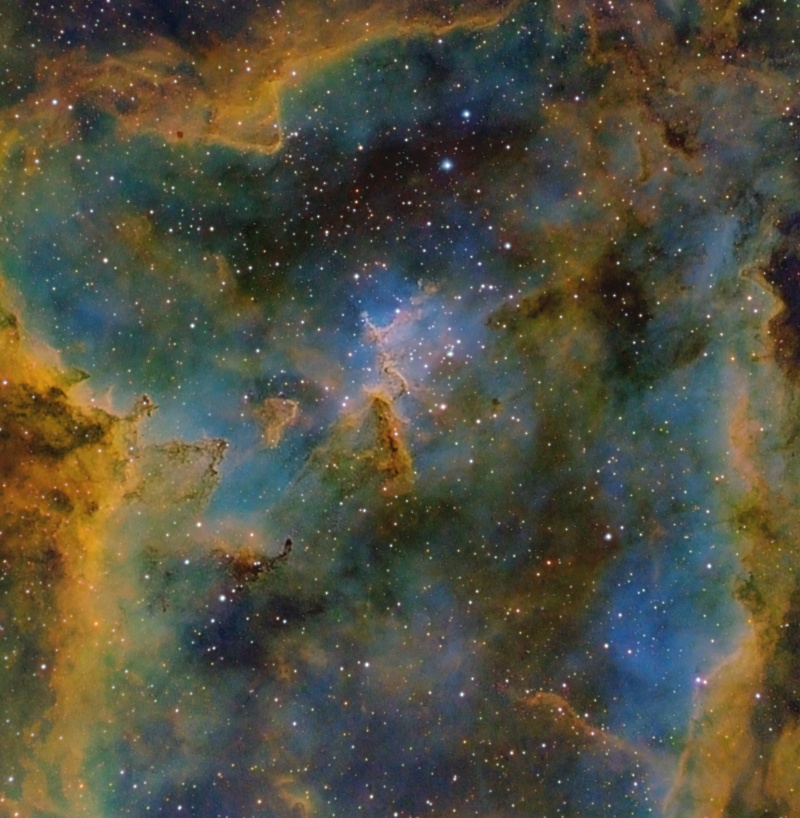
  • Astronomy Picture Of The Day | Melotte 15 in the Heart

    Melotte 15 in the Heart Image Credit & Copyright: Derek Santiago

    Explanation: Cosmic clouds seem to form fantastic shapes in the central regions of emission nebula IC 1805. Of course, the clouds are sculpted by stellar winds and radiation from massive hot stars in the nebula‘s newborn star cluster, Melotte 15. About 1.5 million years young, the cluster stars are near the center in this colorful skyscape, along with dark dust clouds silhouetted against glowing atomic gas. A composite of narrow and broad band telescopic images, the view spans about 40 light-years and includes emission from hydrogen in green, sulfur in red, and oxygen in blue hues. Wider field images reveal that IC 1805’s simpler, overall outline suggests its popular name – The Heart Nebula. IC 1805 is located about 7,500 light years away toward the constellation Cassiopeia.

  • Astronomy Awe of the Day | Watch the Aurora Borealis Live via Webcam

    Aurora Borealis. From Wikimedia Commons.

    If you’ve even seen the Aurora Borealis live, you know how awe-inspiring it can be. But if you live too far south, or aren’t a night owl, there’s now a way for to you see the aurora, via the web, every night. Last night was the world premier of AuroraMAX – an online observatory which began streaming Canada’s northern lights live over the Internet. “Armchair skywatchers everywhere can now discover the wonder of the northern lights live on their home computer screen,” says Canadian Space Agency President Steve MacLean. “We hope that watching the dance of the northern lights will make you curious about the science of the sky and the relationship we have with our own star, the Sun.” In addition to nightly broadcasts of the aurora, AuroraMAX will help demystify the science behind the phenomenon, offer tips for seeing and photographing auroras, and highlight Canadian research on the SunEarth relationship. The website will also include an image gallery with still photos and movies from previous nights. Auroras occur as charged particles from the Sun collide with gases in Earth’s upper atmosphere. The launch of AuroraMAX coincides with the beginning of aurora season in northern Canada, which generally begins in late August or early September and ends in May. Aurora enthusiasts will be able to follow AuroraMAX through solar maximum, the most active period of the Sun’s 11-year cycle, which should produce more frequent and intense auroras on Earth. Solar maximum is currently expected in 2013. AuroraMAX is a collaborative public engagement initiative between the CSA, the University of Calgary, the City of Yellowknife and Astronomy North.