If you’ve even seen the Aurora Borealis live, you know how awe-inspiring it can be. But if you live too far south, or aren’t a night owl, there’s now a way for to you see the aurora, via the web, every night. Last night was the world premier of AuroraMAX – an online observatory which began streaming Canada’s northern lights live over the Internet. “Armchair skywatchers everywhere can now discover the wonder of the northern lights live on their home computer screen,” says Canadian Space Agency President Steve MacLean. “We hope that watching the dance of the northern lights will make you curious about the science of the sky and the relationship we have with our own star, the Sun.” In addition to nightly broadcasts of the aurora, AuroraMAX will help demystify the science behind the phenomenon, offer tips for seeing and photographing auroras, and highlight Canadian research on the Sun–Earth relationship. The website will also include an image gallery with still photos and movies from previous nights. Auroras occur as charged particles from the Sun collide with gases in Earth’s upper atmosphere. The launch of AuroraMAX coincides with the beginning of aurora season in northern Canada, which generally begins in late August or early September and ends in May. Aurora enthusiasts will be able to follow AuroraMAX through solar maximum, the most active period of the Sun’s 11-year cycle, which should produce more frequent and intense auroras on Earth. Solar maximum is currently expected in 2013. AuroraMAX is a collaborative public engagement initiative between the CSA, the University of Calgary, the City of Yellowknife and Astronomy North.
Tag: sun
-
As the Sun Awakens, NASA Keeps a Wary Eye on Space Weather
Earth and space are about to come into contact in a way that’s new to human history. To make preparations, authorities in Washington DC are holding a meeting: The Space Weather Enterprise Forum at the National Press Club on June 8th.
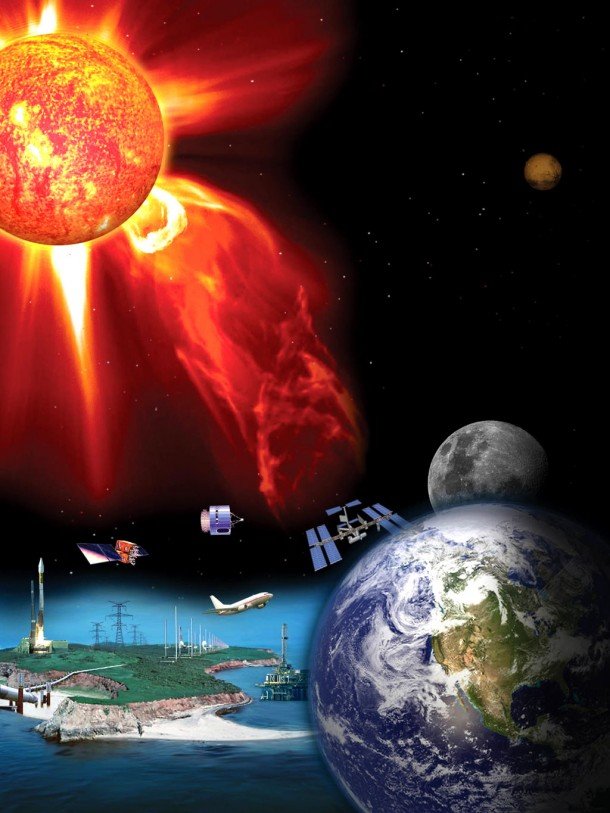
Many technologies of the 21st century are vulnerable to solar storms. Credit: NASA
Richard Fisher, head of NASA’s Heliophysics Division, explains what it’s all about:
“The sun is waking up from a deep slumber, and in the next few years we expect to see much higher levels of solar activity. At the same time, our technological society has developed an unprecedented sensitivity to solar storms. The intersection of these two issues is what we’re getting together to discuss.”
The National Academy of Sciences framed the problem two years ago in a landmark report entitled “Severe Space Weather Events—Societal and Economic Impacts.” It noted how people of the 21st-century rely on high-tech systems for the basics of daily life. Smart power grids, GPS navigation, air travel, financial services and emergency radio communications can all be knocked out by intense solar activity. A century-class solar storm, the Academy warned, could cause twenty times more economic damage than Hurricane Katrina.
Much of the damage can be mitigated if managers know a storm is coming. Putting satellites in ’safe mode’ and disconnecting transformers can protect these assets from damaging electrical surges. Preventative action, however, requires accurate forecasting—a job that has been assigned to NOAA.
“Space weather forecasting is still in its infancy, but we’re making rapid progress,” says Thomas Bogdan, director of NOAA’s Space Weather Prediction Center in Boulder, Colorado.
Bogdan sees the collaboration between NASA and NOAA as key. “NASA’s fleet of heliophysics research spacecraft provides us with up-to-the-minute information about what’s happening on the sun. They are an important complement to our own GOES and POES satellites, which focus more on the near-Earth environment.”
[youtube=http://www.youtube.com/watch?v=Ctjb-f75PkY]
Among dozens of NASA spacecraft, he notes three of special significance: STEREO, SDO and ACE.
STEREO (Solar Terrestrial Relations Observatory) is a pair of spacecraft stationed on opposite sides of the sun with a combined view of 90% of the stellar surface. In the past, active sunspots could hide out on the sun’s farside, invisible from Earth, and then suddenly emerge over the limb spitting flares and CMEs. STEREO makes such surprise attacks impossible.
SDO (the Solar Dynamics Observatory) is the newest addition to NASA’s fleet. Just launched in February, it is able to photograph solar active regions with unprecedented spectral, temporal and spatial resolution. Researchers can now study eruptions in exquisite detail, raising hopes that they will learn how flares work and how to predict them. SDO also monitors the sun’s extreme UV output, which controls the response of Earth’s atmosphere to solar variability.
Bogdan’s favorite NASA satellite, however, is an old one: the Advanced Composition Explorer (ACE) launched in 1997. “Where would we be without it?” he wonders. ACE is a solar wind monitor. It sits upstream between the sun and Earth, detecting solar wind gusts, billion-ton CMEs, and radiation storms as much as 30 minutes before they hit our planet.
“ACE is our best early warning system,” says Bogdan. “It allows us to notify utility and satellite operators when a storm is about to hit.”
NASA spacecraft were not originally intended for operational forecasting—”but it turns out that our data have practical economic and civil uses,” notes Fisher. “This is a good example of space science supporting modern society.”
2010 marks the 4th year in a row that policymakers, researchers, legislators and reporters have gathered in Washington DC to share ideas about space weather. This year, forum organizers plan to sharpen the focus on critical infrastructure protection. The ultimate goal is to improve the nation’s ability to prepare, mitigate, and respond to potentially devastating space weather events.
“I believe we’re on the threshold of a new era in which space weather can be as influential in our daily lives as ordinary terrestrial weather.” Fisher concludes. “We take this very seriously indeed.”