Praying is just a sign that you have accepted the mental masturbation of religion.
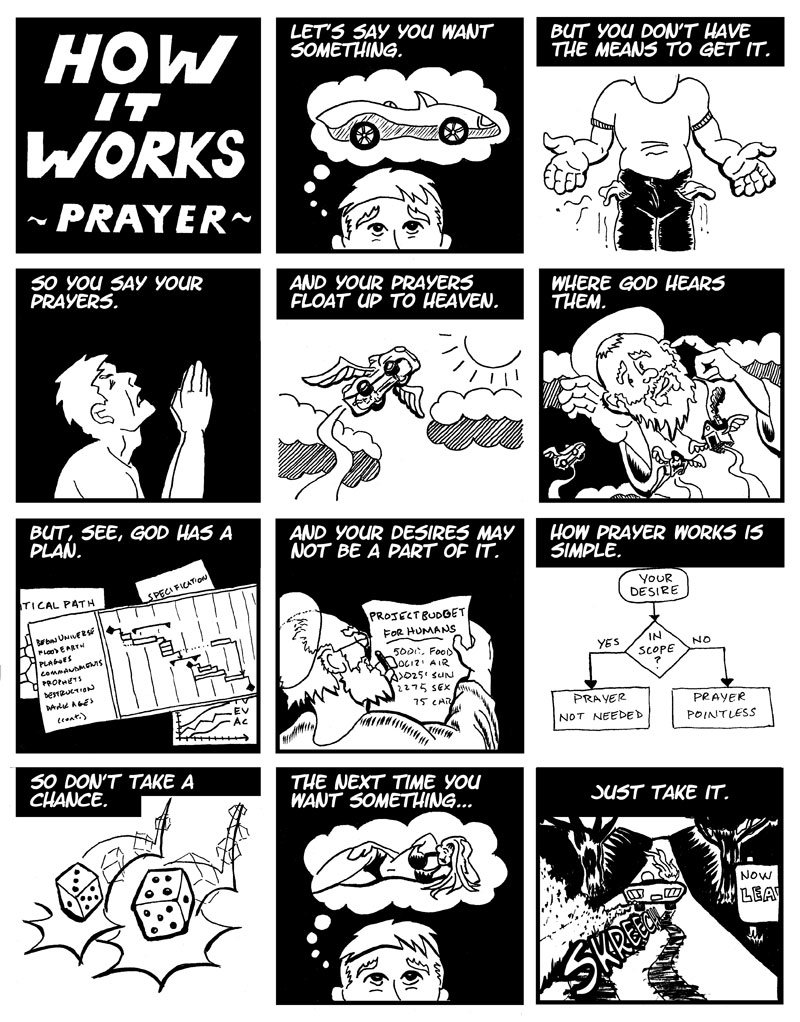
The argument in this cartoon is invalid because it ignores the possibility of value pluralism within “God’s great plan.” In other words, it assumes that any given set of mutually exclusive desires will contain only one desire compatible with said “plan.” After all, if several of two or more competing desires fit equally well with the “plan,” prayer might help tip the scales in favor of one option or another, and your argument would be invalid. However, that view is completely unfounded, and actually begins to seem actively absurd when scrutinized more closely. A though experiment will quickly illustrate what I mean (in it, I will, for the sake of argument, take for granted the truth of Christianity, which I assume is the religion you’re trying to lampoon).
Imagine that two newly-graduated seminary students, X and Y, both apply for the same vacant job at a rectory, and that X prays that he will get the job while Y does not pray. Now, in order for your objection against prayer to be valid, only one of the two possible outcomes here (X getting the job or Y getting the job) can be compatible with “God’s great plan.” Only then would X’s prayers be ineffectual, since God has already decided whether or not X will be employed. But if both X and Y are sufficiently pious and competent to perform the job in a way compatible with “God’s great plan,” prayer might make all the difference in the world, potentially tipping the scales in favor of either X or Y.
Now imagine that X and Y are only two applicants among several hundred. How plausible is it that precisely one of those applicants will fill the position in a way compatible with “God’s great plan?” Why should this theologically, philosophically, and logically unproven, unfounded, and improbable arrangement repeat itself with every mutually exclusive set of desires that has ever existed or will ever exist? (Which it must in order for your argument against prayer to be valid.) Furthermore, doesn’t a state of affairs such as that outlined above, in which only one outcome is possible in any conflict of interest, manifestly violate the idea of free will, and therefore the concept of moral culpability?
Despite what this cartoon implies, the concept of prayer makes perfect sense within the framework of the Christian religion or any other theistic belief system. Of course, the truth of Christianity itself is another debate entirely.

Naughty but nice
Praying is just a sign that you have accepted the mental masturbation of religion.
The argument in this cartoon is invalid because it ignores the possibility of value pluralism within “God’s great plan.” In other words, it assumes that any given set of mutually exclusive desires will contain only one desire compatible with said “plan.” After all, if several of two or more competing desires fit equally well with the “plan,” prayer might help tip the scales in favor of one option or another, and your argument would be invalid. However, that view is completely unfounded, and actually begins to seem actively absurd when scrutinized more closely. A though experiment will quickly illustrate what I mean (in it, I will, for the sake of argument, take for granted the truth of Christianity, which I assume is the religion you’re trying to lampoon).
Imagine that two newly-graduated seminary students, X and Y, both apply for the same vacant job at a rectory, and that X prays that he will get the job while Y does not pray. Now, in order for your objection against prayer to be valid, only one of the two possible outcomes here (X getting the job or Y getting the job) can be compatible with “God’s great plan.” Only then would X’s prayers be ineffectual, since God has already decided whether or not X will be employed. But if both X and Y are sufficiently pious and competent to perform the job in a way compatible with “God’s great plan,” prayer might make all the difference in the world, potentially tipping the scales in favor of either X or Y.
Now imagine that X and Y are only two applicants among several hundred. How plausible is it that precisely one of those applicants will fill the position in a way compatible with “God’s great plan?” Why should this theologically, philosophically, and logically unproven, unfounded, and improbable arrangement repeat itself with every mutually exclusive set of desires that has ever existed or will ever exist? (Which it must in order for your argument against prayer to be valid.) Furthermore, doesn’t a state of affairs such as that outlined above, in which only one outcome is possible in any conflict of interest, manifestly violate the idea of free will, and therefore the concept of moral culpability?
Despite what this cartoon implies, the concept of prayer makes perfect sense within the framework of the Christian religion or any other theistic belief system. Of course, the truth of Christianity itself is another debate entirely.