Tag: Astronomy Picture of the Day

  • Astronomy Picture Of The Day | Melotte 15 in the Heart

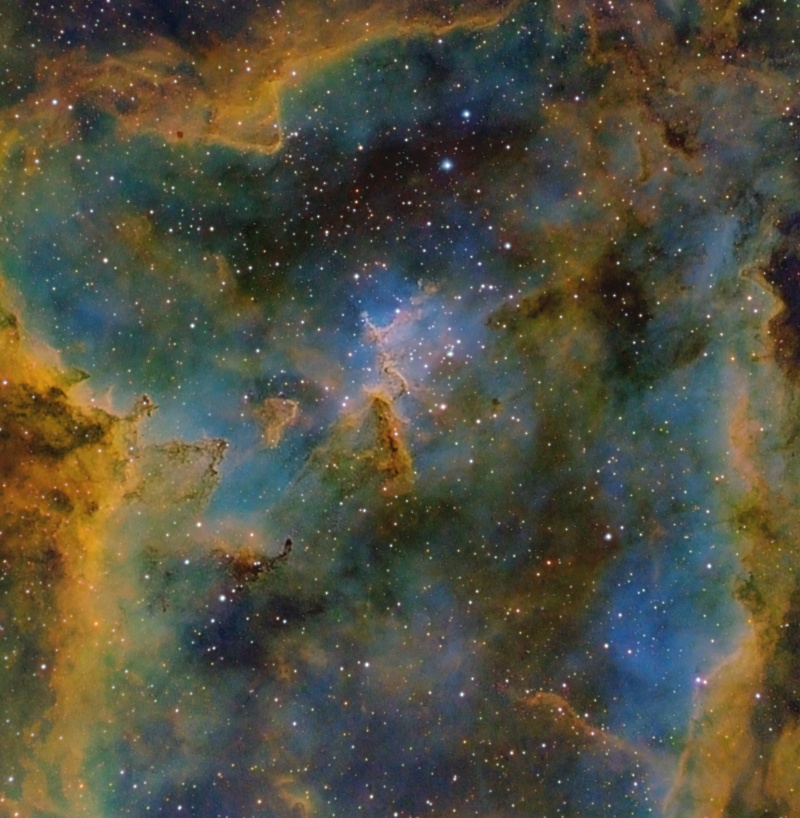
    Melotte 15 in the Heart Image Credit & Copyright: Derek Santiago

    Explanation: Cosmic clouds seem to form fantastic shapes in the central regions of emission nebula IC 1805. Of course, the clouds are sculpted by stellar winds and radiation from massive hot stars in the nebula‘s newborn star cluster, Melotte 15. About 1.5 million years young, the cluster stars are near the center in this colorful skyscape, along with dark dust clouds silhouetted against glowing atomic gas. A composite of narrow and broad band telescopic images, the view spans about 40 light-years and includes emission from hydrogen in green, sulfur in red, and oxygen in blue hues. Wider field images reveal that IC 1805’s simpler, overall outline suggests its popular name – The Heart Nebula. IC 1805 is located about 7,500 light years away toward the constellation Cassiopeia.

  • Astronomy Picture of the Day | NASA’s Hubble Harvests Distant Solar System Objects

    Beyond the orbit of Neptune reside countless icy rocks known as trans-Neptunian objects (TNOs). One of the biggest, Pluto, is classified as a dwarf planet. The region also supplies us with comets such as famous Comet Halley. Most TNOs are small and receive little sunlight, making them faint and difficult to spot.

    This is an artist’s concept of a craggy piece of Solar System debris that belongs to a class of bodies called trans-Neptunian objects (TNOs). Credit: NASA, ESA, and G. Bacon (STScI)

    Now, astronomers using clever techniques to cull the data archives of NASA’s Hubble Space Telescope have added 14 new TNOs to the catalog. Their method promises to turn up hundreds more.

    “Trans-Neptunian objects interest us because they are building blocks left over from the formation of the solar system,” explained lead author Cesar Fuentes, formerly with the Harvard-Smithsonian Center for Astrophysics and now at Northern Arizona University.

    As TNOs slowly orbit the sun, they move against the starry background, appearing as streaks of light in time exposure photographs. The team developed software to analyze hundreds of Hubble images hunting for such streaks. After promising candidates were flagged, the images were visually examined to confirm or refute each discovery.

    Most TNOs are located near the ecliptic — a line in the sky marking the plane of the solar system (since the solar system formed from a disk of material). Therefore, the team searched within 5 degrees of the ecliptic to increase their chance of success.

    They found 14 objects, including one binary (two TNOs orbiting each other like a miniature Pluto-Charon system). All were very faint, with most measuring magnitude 25-27 (more than 100 million times fainter than objects visible to the unaided eye).

    By measuring their motion across the sky, astronomers calculated an orbit and distance for each object. Combining the distance and brightness (plus an assumed albedo or reflectivity), they then estimated the size. The newfound TNOs range from 25 to 60 miles (40-100 km) across.

    Unlike planets, which tend to have very flat orbits (known as low inclination), some TNOs have orbits significantly tilted from the ecliptic (high inclination). The team examined the size distribution of TNOs with low- versus high-inclination orbits to gain clues about how the population has evolved over the past 4.5 billion years.

    Generally, smaller trans-Neptunian objects are the shattered remains of bigger TNOs. Over billions of years, these objects smack together, grinding each other down. The team found that the size distribution of TNOs with low- versus high-inclination orbits is about the same as objects get fainter and smaller. Therefore, both populations (low and high inclination) have similar collisional histories.

    This initial study examined only one-third of a square degree of the sky, meaning that there is much more area to survey. Hundreds of additional TNOs may lurk in the Hubble archives at higher ecliptic latitudes. Fuentes and his colleagues intend to continue their search.

    “We have proven our ability to detect and characterize TNOs even with data intended for completely different purposes,” Fuentes said.

    The Hubble Space Telescope is a project of international cooperation between NASA and the European Space Agency. NASA’s Goddard Space Flight Center manages the telescope. The Space Telescope Science Institute (STScI) conducts Hubble science operations.

    Headquartered in Cambridge, Mass., the Harvard-Smithsonian Center for Astrophysics (CfA) is a joint collaboration between the Smithsonian Astrophysical Observatory and the Harvard College Observatory. CfA scientists, organized into six research divisions, study the origin, evolution and ultimate fate of the universe.


  • Astronomy Picture Of The Day | GRO J1655-40: Evidence for a Spinning Black Hole

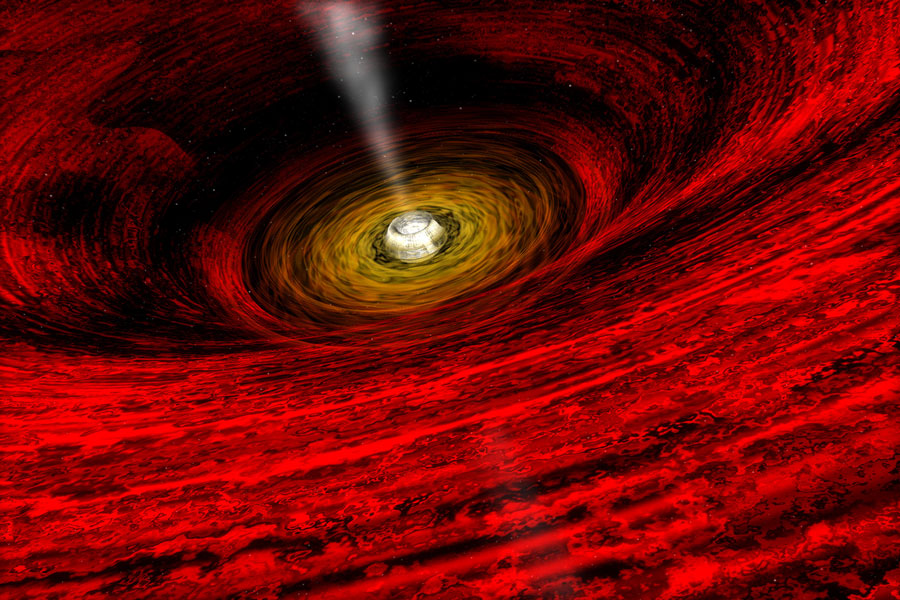
    GRO J1655-40: Evidence for a Spinning Black Hole
    Credit: April Hobart, CXC

    Explanation: In the center of a swirling whirlpool of hot gas is likely a beast that has never been seen directly: a black hole. Studies of the bright light emitted by the swirling gas frequently indicate not only that a black hole is present, but also likely attributes. The gas surrounding GRO J1655-40, for example, has been found to display an unusual flickering at a rate of 450 times a second. Given a previous mass estimate for the central object of seven times the mass of our Sun, the rate of the fast flickering can be explained by a black hole that is rotating very rapidly. What physical mechanisms actually cause the flickering — and a slower quasi-periodic oscillation (QPO) — in accretion disks surrounding black holes and neutron stars remains a topic of much research.