Tag: Astronomy Picture of the Day

  • Astronomy Picture of the Day | Spiral Galaxy IC342

    ic342-1000

    Spiral Galaxy IC342 is located roughly 11 million light-years from Earth in the constellation Camelopardalis, “the giraffe.” Its face-on appearance in the sky—as opposed to our tilted and edge-on views of many other nearby galaxies, such as the large spiral galaxy Andromeda (M31)—makes IC342 a prime target for studies of star formation and astrochemistry.

    The image, obtained in late 2006, was taken using the 64-megapixel Mosaic-1 digital imager on the Mayall 4-meter telescope. This image is the subject of NOAO press release 07-03

  • Astronomy Picture of the Day | A Giant Planet for Beta Pic

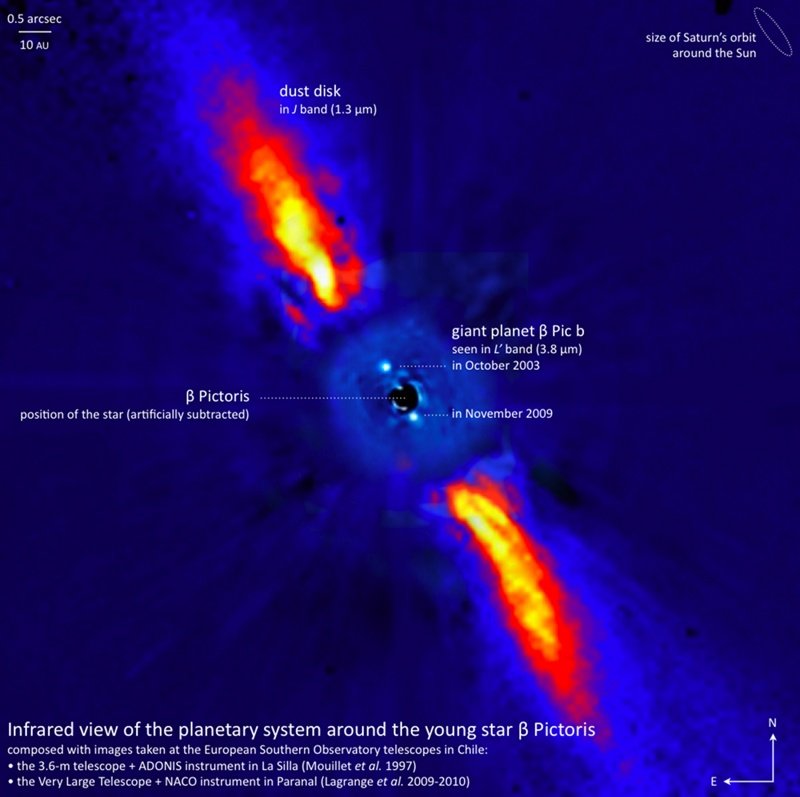
    A Giant Planet for Beta Pic
    Credit: A.-M. Lagrange, D. Ehrenreich (LAOG), et al., ESO

    Explanation: A mere 50 light-years away, young star Beta Pictoris became one of the most important stars in the sky in the early 1980s. Satellite and ground-based telescopic observations revealed the presence of a surrounding outer, dusty, debris disk and an inner clear zone about the size of our solar system — strong evidence for the formation of planets. Infrared observations from European Southern Observatory telescopes subsequently detected a source in the clear zone, now confirmed as a giant planet orbiting Beta Pic. The confirmation comes as the planet is detected at two different positions in its orbit. Designated Beta Pictoris b, the giant planet must have formed rapidly as Beta Pic itself is only 8 to 20 million years old. With an orbital period estimated between 17 and 44 years, Beta Pictoris b could lie near the orbit of Saturn if found in our solar system, making it the closest planet to its parent star directly imaged … so far.

  • Astronomy Picture of the Day | Companion of a Young, Sun-like Star Confirmed

    Companion of a Young, Sun-like Star Confirmed
    Credit: Gemini Observatory, D. Lafreniere, R. Jayawardhana, M. van Kerkwijk (Univ. Toronto)

    Explanation: The first direct image of an extrasolar planet orbiting a star similar to our Sun has been confirmed. Located just 500 light-years away toward the constellation Scorpius, the parent star, cataloged as 1RXS J160929.1-210524, is only slightly less massive and a little cooler than the Sun. The star is, however, much younger, a few million years old compared to the middle-aged Sun’s 5 billion years. This sharp infrared image shows the young star’s planetary companion positioned above and left of center. The planet is estimated to have a mass about 8 times the mass of Jupiter, and orbit a whopping 330 times the Earth-Sun distance from its parent star. The young planetary companion is still hot and relatively bright in infrared light, likely due to the heat generated during its formation by gravitational contraction. In fact, such newborn planets are easier to detect before they age and cool and become much more faint. The discovery image, shown above, was taken in 2008 but confirmed only recently by noting that the planet stayed with its parent star as background stars slightly shifted over time.